

One month before the first national team steps onto the tatami in Hangzhou, the second Karate World Cup will take shape far from China, in Madrid. On Tuesday 20 October at 14:00 CET, the World Karate Federation will hold the draw for its world championship for national teams, broadcast live and free on the WKF YouTube channel, and with it the groups and the route that every qualified nation will have to follow towards the titles awarded from 20 to 22 November in the capital of Zhejiang province. The ceremony arrives two days after the close of the World Cadet, Junior and U21 Championships in Bielsko-Biała, so that the WKF's calendar moves straight from its youngest athletes to its senior national teams.
Four champions at the microphone
The draw will be conducted by Karla Encarnacion, the WKF's Community Manager, and Billy Brennan, the federation's commentator, under the supervision of Marton Falusi, chair of the WKF Organising Commission. Four athletes will join them online, each leading the selection for one category and commenting on its outcome. Antonio Díaz of Venezuela, a two-time world champion and Olympian who sits on the WKF Athletes Commission, will take charge of male team kata, while Mo Sheung Grace Lau of Hong Kong, the reigning world champion and Grand Winner in individual kata and also a member of the Athletes Commission, will handle female team kata. Elena Quirici of Switzerland, a three-time continental champion and another voice of the Athletes Commission, will draw female team kumite, and Christos Stefanos Xenos of Greece, a world champion and two-time continental title-holder, will complete the cast with male team kumite. The choice says something about the event itself: four athletes known above all for their individual careers are lending their faces to a competition in which no one wins alone.
Twenty nations per category, one podium each
The format, set out in the official bulletin, is built for a compact weekend. Up to eighty teams can qualify, twenty in each of the four categories, with a limit of one team per country per category. In each category the twenty teams are split into four groups of five that play a round-robin, after which the top two of each group enter the quarter-finals; the winners go on to the semi-finals, the two beaten semi-finalists meet for a single bronze medal, and each category therefore crowns one gold, one silver and one bronze. The draw on 20 October, held under point 3.1 of the WKF Qualification System for Karate World Cups, will decide who shares those groups. The squads themselves reflect the nature of each discipline: kata teams line up three athletes plus one substitute, women's kumite teams count four or five competitors, and men's kumite teams seven or eight.
Three days in Linping
The competition will be held at the Sports Center Gymnasium in Hangzhou's Linping district, a hall of 4,200 seats around a central court 46 metres long and 28.5 metres wide that has already staged the karate event of the 19th Asian Games, the 20th Asian Senior Karate Championships, the 3rd Asian Para Karate Championships and the Karate 1-Premier League Hangzhou 2025. In his welcome message, WKF President Antonio Espinós describes China as one of the fastest-growing countries in karate and thanks the Chinese Karate Association and its president, Zhang Zhi, for hosting the event. Friday 20 November will belong to female kata and male kumite, with the group phase and quarter-finals; Saturday 21 to male kata and female kumite, before the semi-finals of all four categories in the late afternoon. On Sunday 22 the medal matches begin at 11:00 local time with male team kata, followed by female kumite, then female kata after the lunch break, before the male kumite final at 16:45 and the closing ceremony at 18:00. The whole competition will be streamed on the WKF YouTube channel, with the eliminations open to a worldwide audience and the medal bouts reserved for members of the channel's "Karate Fans" programme.
The memory of Pamplona
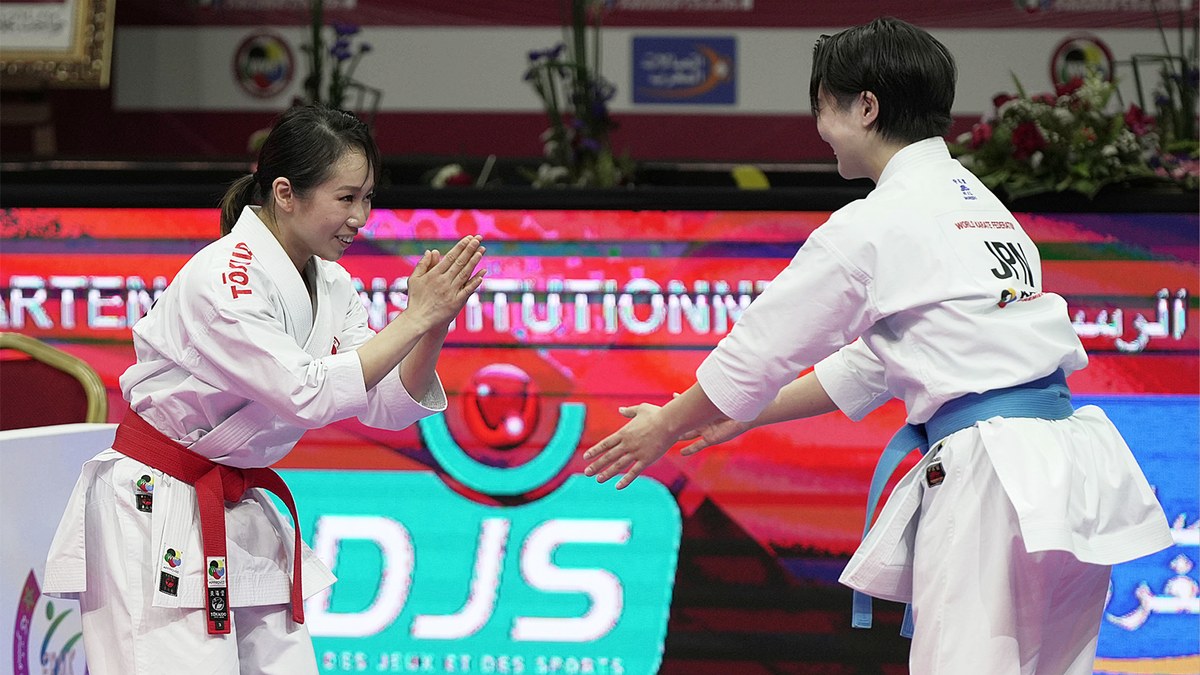
Hangzhou inherits a format that is still very young. The first Karate World Cup was held at the Navarra Arena in Pamplona from 22 to 24 November 2024, the first standalone team championship after the WKF separated its senior world championships into individual and team competitions, and it brought together 43 nations from all five continents. Japan topped the medal table with three titles: a fourteenth world crown and a fifth in a row in male team kata, won against Türkiye, a fifteenth in female team kata against Portugal, and a first female team kumite title since 2006, won 2–0 in the final against the United States, whose silver was the best result in American women's kumite. Egypt, meanwhile, won its first world title in male team kumite by beating the Islamic Republic of Iran 3–0. Each winner lifted a trophy designed for the competition, a globe encircled by five belts representing the continents. On 20 October, the four groups of each category will tell the first chapter of the second edition.
Photo: wkf.net
Sources
- WKF – Karate World Cup Draw to Take Place Live on 20 October (8 October 2026)
- WKF – 2026 Karate World Cup, event page
- WKF – 2026 Karate World Cup Hangzhou, bulletin (PDF)
- WKF – Karate World Cup Hangzhou, competition programme (PDF)
- WKF – All You Need to Know About 2026 World Cadet, Junior & U21 Championships (9 October 2026)
- WKF – Karate World Cup 2024: All You Need to Know About the Historic Event (21 November 2024)
- WKF – Japan Dominates as Spectacular and Historic Karate World Cup Wraps Up in Pamplona (24 November 2024)
- WKF – Team USA Celebrates Historic Silver Medal at Karate World Cup (27 November 2024)