
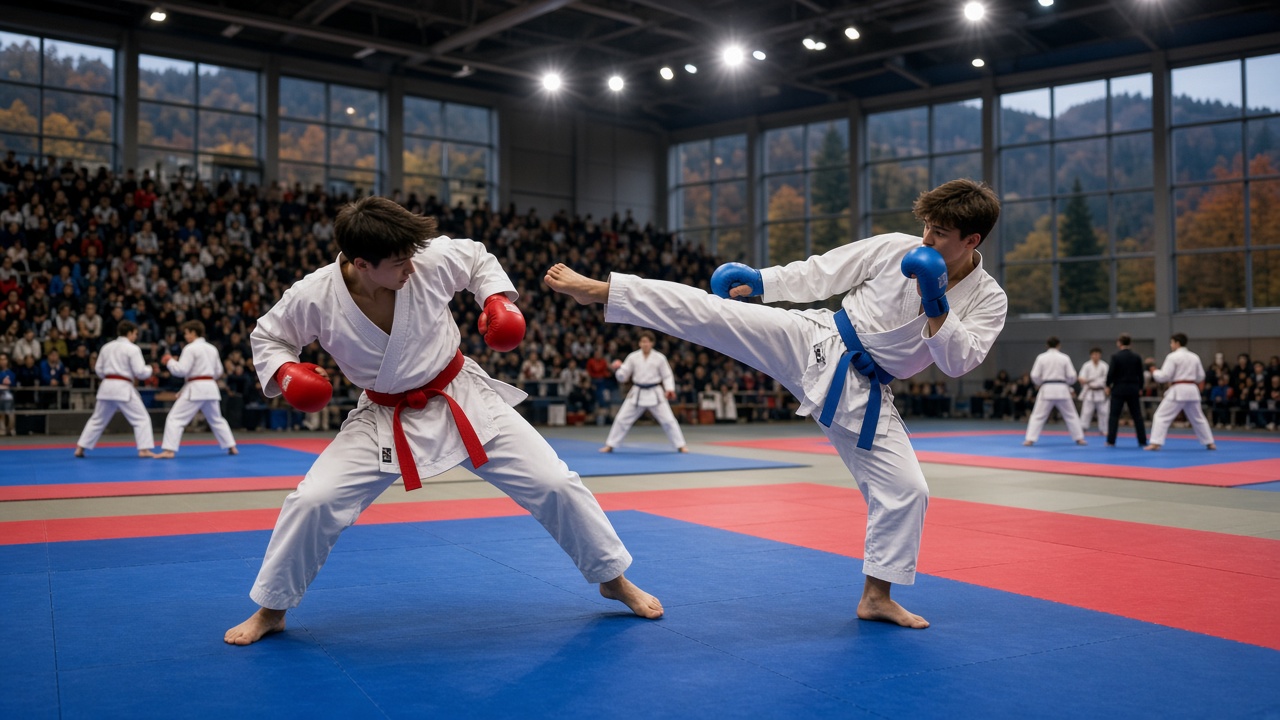
In mid-October, a city in southern Poland that has spent this year as the country’s capital of culture will turn into something else for five days. From 14 to 18 October 2026, the 14th WKF World Cadet, Junior & U21 Championships will bring the most promising young karateka on the planet to Bielsko-Biała, and the provisional entry lists already suggest an event of a scale the city has never hosted.
A city that has earned its tatami
Bielsko-Biała did not land this championship by chance. In his foreword to the official bulletin, the World Karate Federation President calls the city “another important hub of international karate” after the successful 2024 edition in Venice-Jesolo. He also recalls the Polish Open, the karate competition of the 2023 European Games and the 2025 EKF Cadet, Junior & U21 Championships, all of which passed through the same arena.
That arena is the Hala Widowiskowo-Sportowa im. Zbigniewa Pietrzykowskiego, also known as Pod Dębowcem, on ul. Karbowa 26. It is named after a celebrated Polish boxer, and it has become a familiar home for karate. The organiser is the Polish Karate Union, which is based in the city and led by its president, Paweł Połtorzecki. The WKF credits the union with the “outstanding disposition and courage” needed to host one of the most important karate events of the year.
The city around the hall adds its own character. The bulletin describes a place of nearly 170,000 people at the foot of the Beskid Mountains. It is often called a “Little Vienna”, and its Art Nouveau streets carry traces of Polish, Czech, Austrian and German influence. In January, in the presence of Poland’s Minister of Culture, Bielsko-Biała opened its year as the first Polish Capital of Culture, a title that passes to Katowice in 2027. The mayor’s greeting in the bulletin makes the link with sport directly: “We are already the Polish Capital of Culture, and from October 14 to 18, we will also be — I have no doubt about it — the World Capital of Karate.”
Advertisement
Three generations, one stage
What makes this championship unique on the WKF calendar is its range. Cadets are 14 and 15, juniors 16 and 17, and the Under-21 division covers athletes aged 18 to 20. Eligibility is set by age on the first day of the event, 14 October. Each age group has individual kata and individual kumite for men and women. Team kata brings cadets and juniors together in a single combined category for each gender, open to athletes aged 14 to 17.
Kumite is split into a full set of weight categories, from the cadet girls’ under-47 kg weight category up to the U21 men’s over-84 kg weight category. Thirty-seven categories in all will crown world champions in Bielsko-Biała, each one a separate story waiting to be written on the tatami.
The shape of the week
The official programme divides the week into two parts. The working days come first. The referee course starts on 8 October, delegations register from Monday 12 October, and weigh-ins run by age group across three days. On Tuesday 13 October the WKF Congress meets at the Redutowa Palace, and the coaches’ meeting and draw take place the same afternoon.
The competition opens on Wednesday 14 October. In the morning come the U21 individual kata eliminations and the combined cadet-and-junior team kata. From midday until late evening the U21 kumite takes over. Thursday belongs to the juniors, with kata first and then a long kumite session until 20:30. Friday is the cadets’ turn, with kata in the morning and kumite through the afternoon. That evening, at 18:00, the athletes gather for the opening ceremony. First announced for the Wednesday, it has since been moved to Friday, where it now forms a bridge to the medal weekend.
Saturday 17 October is finals day for the youngest. Cadet bronze-medal bouts begin at 10:00, and the cadet finals follow from 11:15, kata first, then kumite. After a lunch break the juniors return at 15:00 for their bronze bouts, and their finals start at 16:30. Sunday 18 October puts the Under-21s in the spotlight. Their finals start at 12:15, the cadet-and-junior team kata finals follow at 15:00, and the closing ceremony is set for 15:45. Spectators can buy day tickets for PLN 50 on elimination days and PLN 60 on finals days.
The numbers behind the bow
Ahead of the championships, the WKF announced that more than 1,700 athletes from over 100 countries were expected. When the official entry tables were consulted on 2 October, after athlete registration had closed, they had gone well past that. The tables showed 1,997 entries and 2,053 athletes across 114 delegations, with 1,098 men’s and 899 women’s entries. These figures are provisional and may still change at accreditation and the weigh-in. Still, they suggest the mayor was not exaggerating when he spoke of “most likely the largest sporting event in the history of our city.”
The figures also show the breadth of the field. Eleven delegations, including Egypt, Iran, Türkiye, the United States, Italy, Spain and Germany, have entered 37 athletes, as many as there are categories. Japan, Brazil and Ukraine are close behind. At the other end of the list, Aruba, Ethiopia, Grenada, Kenya and Niger have each entered a single athlete, every one of them a reminder that a world championship is also measured by how far it reaches.
The busiest bracket is the junior men’s under-68 kg weight category, with 71 names. The U21 men’s under-67 kg weight category has 69. In kata, the U21 men’s field of 64 promises a long morning of eliminations, and 25 teams have entered each of the team kata events.
Respect, discipline, effort
The WKF President’s foreword describes these championships as “the biggest celebration of youth karate,” and it rests that claim on values more than numbers: “Respect, discipline, effort, and fair play are present in every bout and every category.” For many of the teenagers arriving in Bielsko-Biała, the week will be a test of everything learned in the dojo. The cadets will step on the scales on Wednesday and wait until Friday to compete. Kata athletes will work through a morning of eliminations for a single chance at the medal rounds.
The names that leave Poland as world champions are still unwritten. What is already clear is the setting: a Polish city with a strong karate tradition, a hall that knows the sport well, and a field larger than first expected, gathering at the foot of the Beskids to see who comes next.
Sources
- https://www.wkf.net/world-championships/championship/!/443/2026-world-cadet-junior-u21-championships-bielsko-biala
- https://www.wkf.net/files/pdf/championships/1st-bulletin-BielskoBiala2026.pdf
- https://www.wkf.net/files/pdf/championships/2nd%20Bulletin\_2026.pdf
- https://www.wkf.net/news-center/article/!/3256/best-sport-to-support-next-generation-of-athletes-at-the-2026-world-cadet-junior-u21-karate-championships
- https://www.wkf.net/calendar
- https://www.gov.pl/web/kultura/zainaugurowalismy-pierwsza-polska-stolice-kultury-bielsko-biala-2026
- https://www.gov.pl/web/kultura/inaugurujemy-projekt-polskie-stolice-kultury-2026-2028
- https://karate-polska.pl/walne-zabranie-puk/
Illustration: karate.news