
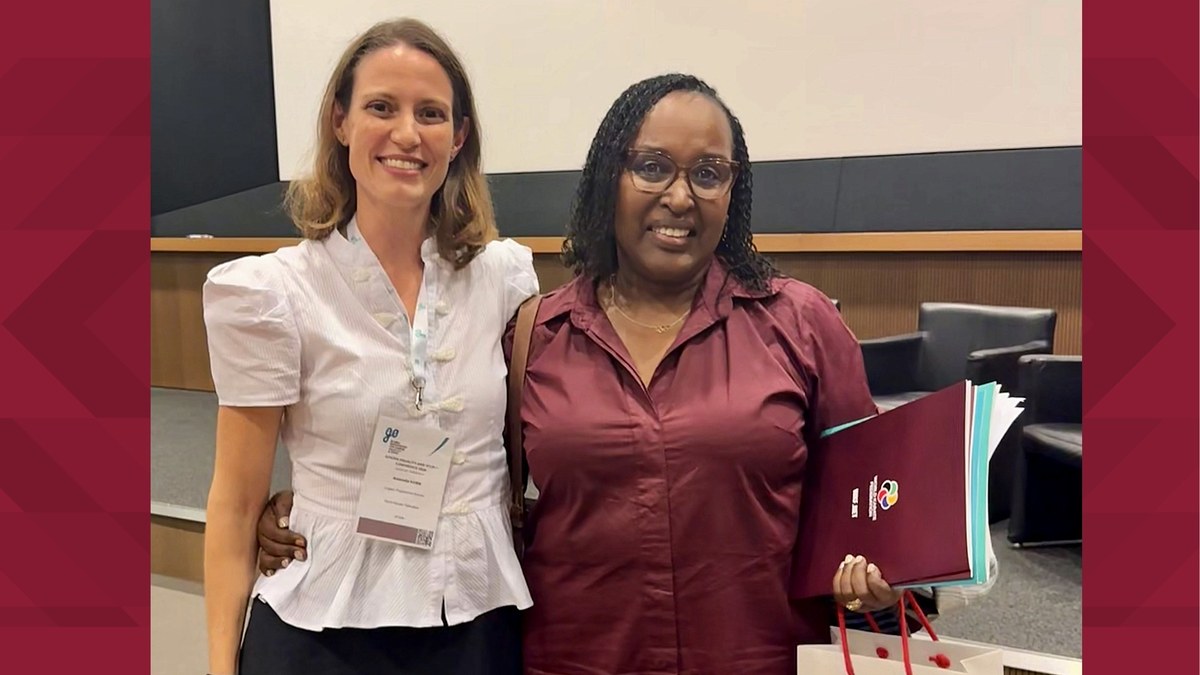
On 29 September, in Lausanne, the Global Observatory for Gender Equality & Sport (GO) brought together representatives of sport, governments, United Nations agencies, academia and civil society for its 2026 Gender Equality and Sport+ Conference, under a theme that reads like an instruction: "Measure to Matter". The aim was to move beyond collecting data and ask how evidence can shape policy, organisational decisions, investment and accountability. Among the participants was the World Karate Federation, represented by its Legacy Programme Director, Antonella Nanni, who joined the discussion on how sport organisations can strengthen gender equality and why cooperation across sectors matters.
A conversation in Lausanne
During the conference, Nanni also met Felicite Rwemarika, member of the International Olympic Committee, board member of the Olympic Refuge Foundation and president of GO, together with members of the Observatory's team, to talk through shared priorities and explore possible areas of cooperation between the two organisations.
The day itself was built around three areas: how evidence travels from data to policy to impact, how to measure what matters for girls beyond participation figures, and how investment and gender budgeting can advance or hold back progress. In its own account of the conference, the Observatory identified a recurring message, that "measurement matters when it leads to action", a useful standard for any federation arriving with a programme to describe.
Four years of Guardian Girls Karate
WKF President Antonio Espinós thanked Nanni and linked her presence in Lausanne to the federation's social legacy work. "Social legacy is truly at the core of the WKF, and we are making major efforts to put the values of Karate into action through our different legacy programmes," he said. "In terms of gender equality, our Guardian Girls Karate programme is expanding globally and has demonstrated its effectiveness in promoting gender equality during its four years of existence. It is a clear example of how Karate can contribute to society."
Guardian Girls Karate was launched in 2022 by the WKF, the Koyamada International Foundation and the United Nations Population Fund (UNFPA) to give women and girls practical tools to respond to situations of gender-based violence through karate training. The course teaches awareness, prevention strategies and simple karate-based techniques, alternating classroom instruction with practical work on the dojo floor, and it is carried from country to country by certified instructors, trained to implement the programme in their own nations and communities.
From Tokyo to Almaty
This year has shown that model at work. In Tokyo, on 7 and 8 March 2026, in the days around International Women's Day, the WKF head instructors Amy Connell and Teresa García led an instructors' course for Asia that ended with sixteen women certified, six of them from Japan, two from Indonesia and one each from eight other countries and territories of the region, followed by an open seminar for thirty women. The WKF General Secretary, Toshihisa Nagura, framed the diploma as a beginning: "It's not a short-term event. It requires patience, persistence and partnership. The course you just completed is the starting point."
The next steps came in May. On 3 May, in Bogor, the Indonesian Karate Federation (PB FORKI) organised an open seminar at the OSH Dojo in Legenda Wisata Cibubur, where the certified instructors Puspa Meonk and Tinne Novita worked with twelve participants, aged from 11 to 69, on basic techniques, self-defence and confidence. In Almaty, the WKF-certified instructor Alexandra Budkina led a second seminar for twenty women.
From Griffith to Mexico City
The fullest version of the programme so far has taken shape in Australia. Since the country's first instructors' course in July 2025, it has built the largest group of WKF-certified instructors anywhere, more than fifty, and by June 2026 it had completed the first full eight-week Guardian Girls course held worldwide, at Griffith University. There, a dozen women learned the basic techniques with the instructor Alex Armour while developing, in the WKF's words, "empowerment attitudes and practical mental and physical tools" to respond to gender-based violence. Espinós called the course "a historic achievement for our programme", one that "demonstrates the positive impact that karate can have beyond sport". At that point, Guardian Girls Karate was implemented through certified instructors in 38 countries on five continents.
In June, Mexico City extended the map. From 12 to 15 June 2026, the Instructors' Course Americas certified 23 women from 17 countries of the continent and brought 13 new countries into the programme. An open seminar drew 146 Mexican women of all ages, and the programme was presented at the headquarters of the Mexican Olympic Committee by José García Maañón, President of the PKF and First Vice President of the WKF, together with the committee's president, María José Alcalá. "The Americas have now joined the initiative," García Maañón said, while Espinós described an event that "completes the series of instructors' courses that have been held around the world".
Kuala Lumpur and what lies ahead
By late summer, the wider Guardian Girls movement had acquired a new national structure. On 28 August 2026, at the Japanese Ambassador's Residence in Kuala Lumpur, Guardian Girls Malaysia was launched as a national platform for the safety, empowerment and leadership of women and girls through combat sports, education and community engagement. The launch was officiated by Malaysia's Deputy Minister of Youth and Sports, Mordi Bimol, alongside figures including the Japanese ambassador, Noriyuki Shikata, Guardian Girls International chairman Shin Koyamada and UNFPA's representative in Malaysia, Julitta Onabanjo. The Malaysia Karate Federation (MAKAF), represented by its Secretary General, Mohd Razlan Shah Mohamad Rabii, took part alongside the country's other national combat sports organisations, with a role the WKF described as reaching "both on and off the tatami".
This is the record the WKF brought to Lausanne: a method delivered in open seminars and now in a full eight-week course, instructors who can be counted country by country, and working ties with national federations, Olympic committees and a United Nations agency. Espinós presented the federation's participation as reinforcing "our commitment to using Karate as a platform for social impact and supporting initiatives that create greater opportunities for women and girls through sport". The conference's theme sets the test for what follows, which is whether the figures the programme can already show, from Bogor to Mexico City, become evidence that shapes decisions.
Sources
- WKF, "WKF Joins Global Conference on Gender Equality and Sport", 3 October 2026
- Global Observatory for Gender Equality & Sport (GO), "Conference 2026", consulted 7 October 2026
- WKF, "Guardian Girls Karate Instructor Course Opens in Tokyo, Marking Key Step for Programme Expansion in Asia", 7 March 2026
- WKF, "Guardian Girls Karate Marks International Women's Day with Key Expansion in Asia at Tokyo Event", 8 March 2026
- WKF, "Guardian Girls Karate Continues Expansion in Asia with Seminars in Indonesia and Kazakhstan", 4 May 2026
- WKF, "Australia Becomes Global Flagship of Guardian Girls Karate with First Full 8-week Course", 5 June 2026
- WKF, "Guardian Girls Karate Expands Across the Americas Following Successful Activities in Mexico City", 19 June 2026
- WKF, "Malaysia Karate Federation Joins Launch of Guardian Girls Malaysia", 2 September 2026
Photo: wkf.net