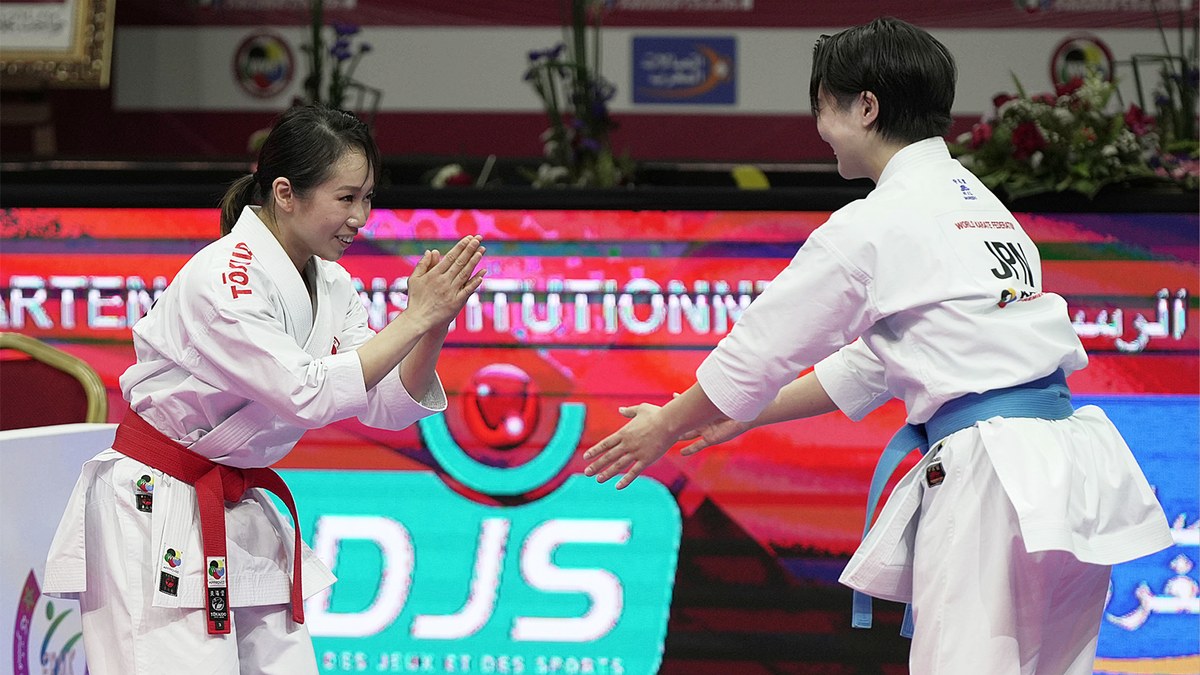


When the 2026 World Cadet, Junior & U21 Championships open in Bielsko-Biała on Wednesday 14 October, the hall will hold more young karateka than any age-group world championship before it. The World Karate Federation counts over 2,000 athletes from 114 countries across all five continents, a record for the event, and the figure says something about the sport that a single bout cannot: the base of the pyramid keeps widening, and it is widening in many places at once.
A curve drawn over five editions
The numbers become meaningful when they are set side by side. In Tenerife in 2017 the championships gathered nearly 1,700 competitors from 107 countries. Two years later in Santiago, in Chile, the field was smaller, nearly 1,500 athletes from 86 countries. Konya, in Türkiye, brought the count back up in 2022 with nearly 1,800 athletes from 98 countries, and Venice-Jesolo in 2024 set a new mark with 1,960 young athletes from 109 countries. Bielsko-Biała now passes the 2,000 line and adds five more nations to the Italian total, so that the curve, apart from Santiago, climbs steadily across nearly a decade.
What the curve measures is not only the size of the entry list but the number of federations able to train cadets, juniors and under-21 athletes to world level and to send them abroad for a week. The WKF reads the figures in that light, as evidence of the growing popularity of youth karate and of its capacity to bring young athletes together across continents. Seen from the hall, the arrival of 114 flags at an age-group event also describes the pool from which the senior championships of the coming years will draw.
Large delegations, many of them
No single country dominates the entry. Croatia, which the WKF describes as a powerhouse nation, leads with 42 athletes, followed by Italy and Slovakia with 41 each, while Türkiye, Germany, France and Egypt each bring 40. The list mixes long-established European schools with Egypt, second in the medal table two years ago, and the spread between the largest teams is narrow enough that the week will be decided on the tatami rather than by weight of numbers.
The last edition offers the reference point. In Venice-Jesolo, Japan, the birthplace of karate, topped the medal table with 15 medals, 12 of them gold. Egypt also won 15 medals including six golds, and the hosts Italy 15 medals with five golds. Three nations with the same medal count but very different tallies of titles: that is the kind of balance the Polish week will test again.
A city that knows the format
The championships are held at the Hala Widowiskowo-Sportowa Pod Dębowcem, and Bielsko-Biała arrives at them with recent experience. The city welcomed the 2025 EKF Cadet, Junior & U21 Championships, staged the karate competition of the 3rd European Games in 2023 and hosts every year the Polish Open, one of the most traditional tournaments on the European calendar. Our preview of the championships sets out the wider context of the week.
Following the week, day by day
The competition uses an elimination and repechage format, with the qualifying rounds spread over three days from 9:00 to 20:30 local time. On Wednesday 14 October the under-21 athletes open the championships, with the eliminations of individual U21 kata, team kata and U21 kumite. Thursday 15 belongs to the juniors in kata and kumite, and on Friday 16 the cadets take their turn. That same Friday at 18:00 the Opening Ceremony brings the delegations together in the venue, after three days in which most of the field will already have competed.
The medal bouts follow over the weekend. On Saturday 17 October the bronze medal bouts and finals run from 10:00 to 19:00, and on Sunday 18 the last session runs from 10:00 to 15:45, all times local, at GMT+2, the same as Paris. On Thursday 15 the WKF also holds its conference Beyond the Tatami, devoted to the careers women build around the sport, which we presented in our article on the event.
Every bout on screen
For the first time in the history of the event, the whole competition, from the first elimination round to the last final, is broadcast live on the WKF YouTube channel. Families and coaches who could not travel will be able to follow any category on any tatami, a change we described in our article on the full streaming. For a record entry of more than 2,000 athletes, it means that every one of them, and not only the finalists, will compete in front of the world.
Sources
- World Karate Federation, All You Need to Know About 2026 World Cadet, Junior & U21 Championships, 9 October 2026
- World Karate Federation, 2026 World Cadet, Junior & U21 Championships Bielsko-Biala, event page
- World Karate Federation, 2nd Bulletin, 2026 World Cadet, Junior & U21 Championships
Photo: wkf.net