
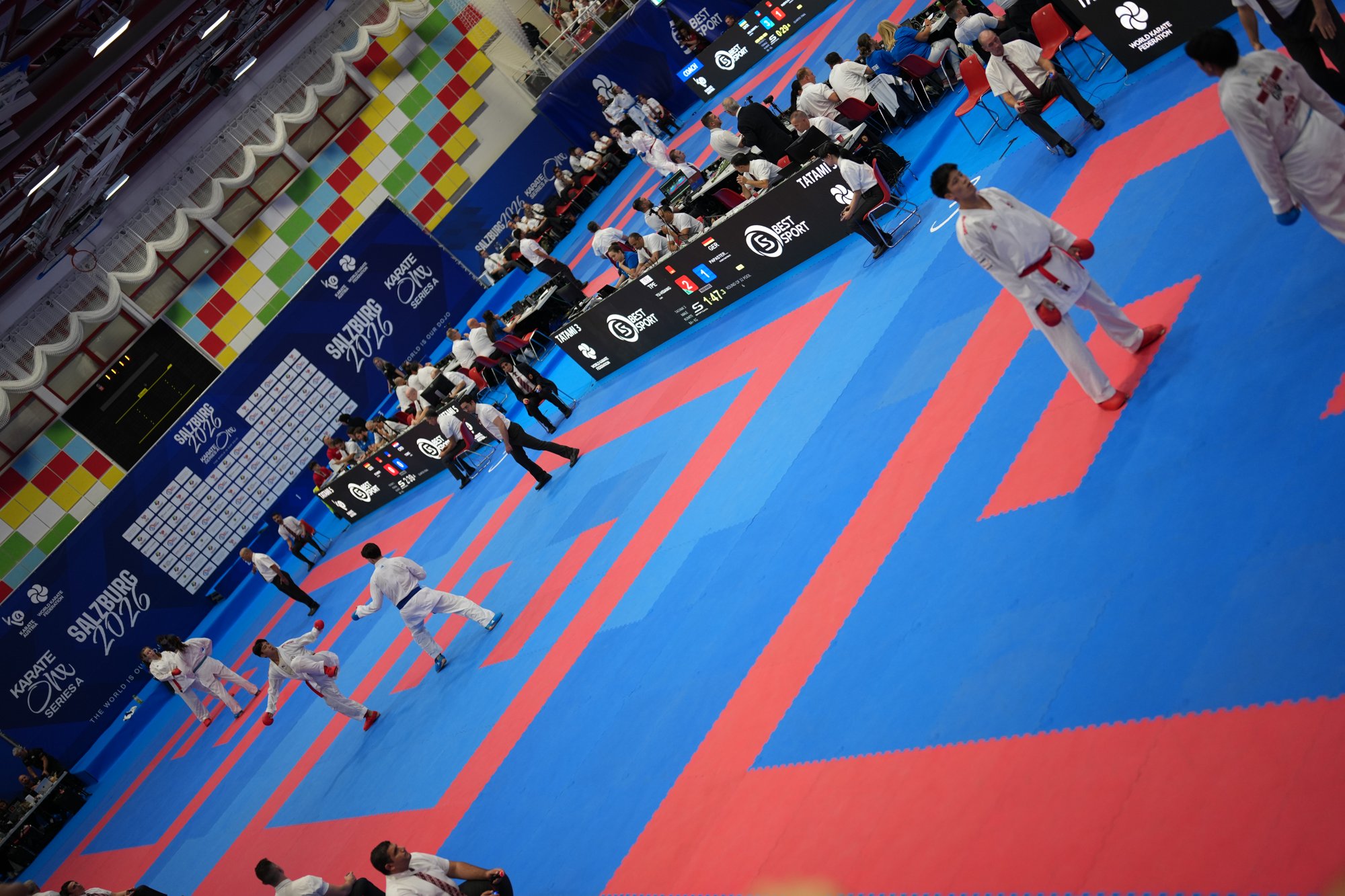
The last Karate One Series A of the 2026 season opened in Salzburg on Friday with four titles and a podium that read like a map of the karate world. Japan took two of the four gold medals, through Ria Hori in female kata and Yosuke Abe in male kumite +84 kg. Sayed Salman Almosawi carried the male kata title home to Kuwait, and Lucija Lesjak won the female kumite +68 kg final for Croatia, beating France’s Zera Jade Ozserttas 8–6. By the time the last bow had been made at the Sporthalle Alpenstrasse, sixteen medals had been shared among fourteen nations from four continents.
A long Friday at the Sporthalle Alpenstrasse
Salzburg is the fourth and final stop of this year’s Series A circuit, after Tbilisi, A Coruña and Guadalajara, and it has drawn the largest field of the four. According to the World Karate Federation, more than 1,200 athletes from 82 countries registered, more than in Tbilisi or A Coruña and more than twice as many as in Guadalajara. Italy arrived with the biggest delegation, 153 athletes, ahead of Germany with 82 and Türkiye with 66.
The Series A is open to every member federation of the WKF, and each competitor in an individual category earns World Ranking points, which gives the closing event of the season a weight of its own. The opening day was reserved for four categories: individual kata for women and men, and the two heaviest weight categories in kumite, female +68 kg and male +84 kg. Everything was decided in a single knockout day, from the eliminations that began at nine in the morning, through the semi-finals and repechages, to the bronze-medal bouts and finals that closed the evening.
Kata: from Japan to the Gulf
In female kata, the title went to Japan’s Ria Hori, who met Belgium’s Chiara Manca in the final and took gold, leaving Manca with silver. The two bronze medals went to France’s Mai Linh Bui and to Tamara Lehner, whose medal gave Austria, the host nation, a place on the podium on the very first day. Just behind them, Italy’s Elena Roversi and Portugal’s Natacha Fernandes both finished fifth, one step short of the medals, while Ana Cruz of Portugal and Sofia Tsagkera of Greece completed the top eight.
Advertisement
Male kata crowned a champion from the Gulf. Kuwait’s Sayed Salman Almosawi won the final against Portugal’s Vasco Mateus, and Portugal thus left the kata tatami with a silver medal among the men and two places in the women’s top eight. The male bronze medals went to Italy’s Luigi Di Rubba and to Kent Oiwa, whose medal put Australia, and with it Oceania, on the Salzburg podium. Italy’s depth showed in the rankings rather than at the very top: Federico Arnone finished fifth and Manuel Grazia seventh, alongside Brazil’s Juan Pinheiro in fifth and Venezuela’s Jeffersont Ortiz Aquino in seventh.
Heavyweight kumite: Lesjak’s points, Abe’s gold
The female kumite +68 kg weight category produced a high-scoring final. Croatia’s Lucija Lesjak and France’s Zera Jade Ozserttas shared fourteen points between them, and Lesjak finished on the right side of an 8–6 scoreline to take gold. The bronze bouts told two very different stories. Amalie Hakova of the Czech Republic edged Croatia’s Sara Tomic 3–2, a single point that kept a second Croatian medal out of reach, while Germany’s Johanna Kneer beat Ukraine’s Kseniia Kolomiitseva more comfortably, 7–3, to give the second-largest delegation in Salzburg its first podium.
In the male kumite +84 kg weight category, the title went to Japan’s Yosuke Abe, who beat Ukraine’s Rizvan Talibov in the final. One of the bronze medals was decided by the narrowest of margins: Mame Gor Diop of Senegal beat Faruk Zeytinci of Türkiye 1–0, bringing Africa onto the podium. Spain’s Freddi Martin Gonzalez took the other bronze, while Italy’s Ettore Mostarda finished fifth, alongside Zeytinci. Germany’s Nikolai Sekot and Switzerland’s Jiyan Buhurcu completed the top eight.
Fourteen nations, four continents
Seen as a whole, the first day was a lesson in how widely the medals can be spread in an open tournament. Japan was the only nation to win two titles, and France the only other nation with two medals, Ozserttas’s silver and Bui’s bronze. Belgium, Portugal and Ukraine each took a silver; Austria, Italy, Australia, the Czech Republic, Germany, Senegal and Spain each took a bronze. Asia provided three of the four champions, through Japan and Kuwait, Europe the fourth, and Africa and Oceania each had a bronze-medal winner of their own.
The Americas did not reach a podium on Friday, though Brazil and Venezuela both placed athletes in the top eight in male kata. Italy, for all the size of its delegation, left the first day with a single medal, Di Rubba’s bronze, but it placed five athletes in the top eight across the four categories, and two more days of competition still lie ahead.
Saturday: team kata and the lighter weights
The tournament continues on Saturday with female and male team kata and four lighter weight categories in kumite: female −50 kg and −55 kg, male −60 kg and −67 kg. Sunday closes the season’s Series A with female −61 kg and −68 kg and male −75 kg and −84 kg. As on Friday, the finals and bronze-medal bouts come at the end of each day, and the whole event is streamed live on the WKF YouTube channel.
Sources
- https://www.wkf.net/karate-one/championship/!/442/2026-karate-one-series-a-salzburg
- https://www.wkf.net/news-center/article/!/3314/all-you-need-to-know-about-karate-one-series-a-salzburg
- https://www.wkf.net/files/pdf/championships/Competition\_Programme\_SA\_Salzburg.pdf
- https://www.wkf.net/files/pdf/championships/Bulletin\_Series\_A\_Salzburg\_2026.pdf
- https://www.youtube.com/user/WKFKarateWorldChamps
Photo: Xavier Servolle