
In Algiers on 9 September, while the city prepared to welcome the continent’s athletes for a championship week that karate.news has already followed on the tatami, the Union of African Karate Federations turned its attention to the quieter work that makes those contests possible. The UFAK General Assembly brought together representatives of African National Federations under the presidency of Souleymane Gaye, UFAK President and member of the World Karate Federation Executive Committee, with WKF President Antonio Espinós in attendance. What unfolded was not a celebration of medals but a deliberate review of how African karate organises itself, accounts for its resources, and charts the seasons ahead.
The room’s purpose was institutional. Delegates examined UFAK’s activities across the continent, received the certified accounts for 2025, and discussed the provisional budget for 2026. Governance sat beside finance: stronger structures inside National Federations, clearer administration, and a shared insistence on transparency, coordination and communication as the ground on which growth can stand. Digital development of the continental federation featured among the priorities, a reminder that modern sport runs as much on systems and information as on training halls.
Bechir Cherif, UFAK Regional Coordinator and WKF Vice President, presented an overview of work carried out in Africa’s different regions. His brief underlined how regional programmes support athletes and National Federations while tightening cooperation from one part of the continent to another. In that framing, the Assembly was less a single capital’s meeting than a snapshot of a federation trying to keep its regions talking to one another—and to keep those conversations useful for the people who compete and the federations that send them.
Major events framed the near horizon. The 2026 UFAK Championships in Algiers and the 2026 Karate World Cup were on the table, alongside preparation of the UFAK calendar for 2027. Setting that calendar is never a clerical afterthought: it shapes when athletes peak, when National Federations plan travel and selection, and how African karate places itself inside a crowded international year. By placing 2027 on the agenda in September 2026, UFAK signalled that continental planning would not wait for the dust of the current season to settle.
Governance discussion returned repeatedly to the quality of institutions. Participants spoke of the need for stronger institutional structures and effective administration within National Federations—language that sounds dry until one remembers that Olympic pathways, continental ranking, and the credibility of results all depend on federations that can run cleanly, communicate clearly, and coordinate across borders. Transparency was named not as a slogan but as a foundation, together with coordination and communication, for the continued growth of African karate.
Antonio Espinós, speaking after the meeting, cast that institutional strength in Olympic terms. “Having a strong African continental federation is essential to the future of karate, especially for our Olympic prospects,” he said. “To achieve this, we require the cooperation of all the National Federations in Africa. We must work united towards our common goals and ensure that the progress that we have experienced in Africa over the last few years does not stop here but continues to be a tremendous asset to take Karate even further. I want to thank all the African National Federations for their contribution to the expansion of karate across the continent and UFAK President Souleymane Gaye for his leadership.”
The quote matters because it places Africa not at the margin of the Olympic conversation but inside it. Espinós did not treat continental unity as a courtesy; he treated it as a condition. Cooperation among National Federations, continuity of recent progress, and leadership at UFAK level appear in his remarks as linked requirements: without them, the sports wider ambitions lose a pillar they can ill afford to lose.
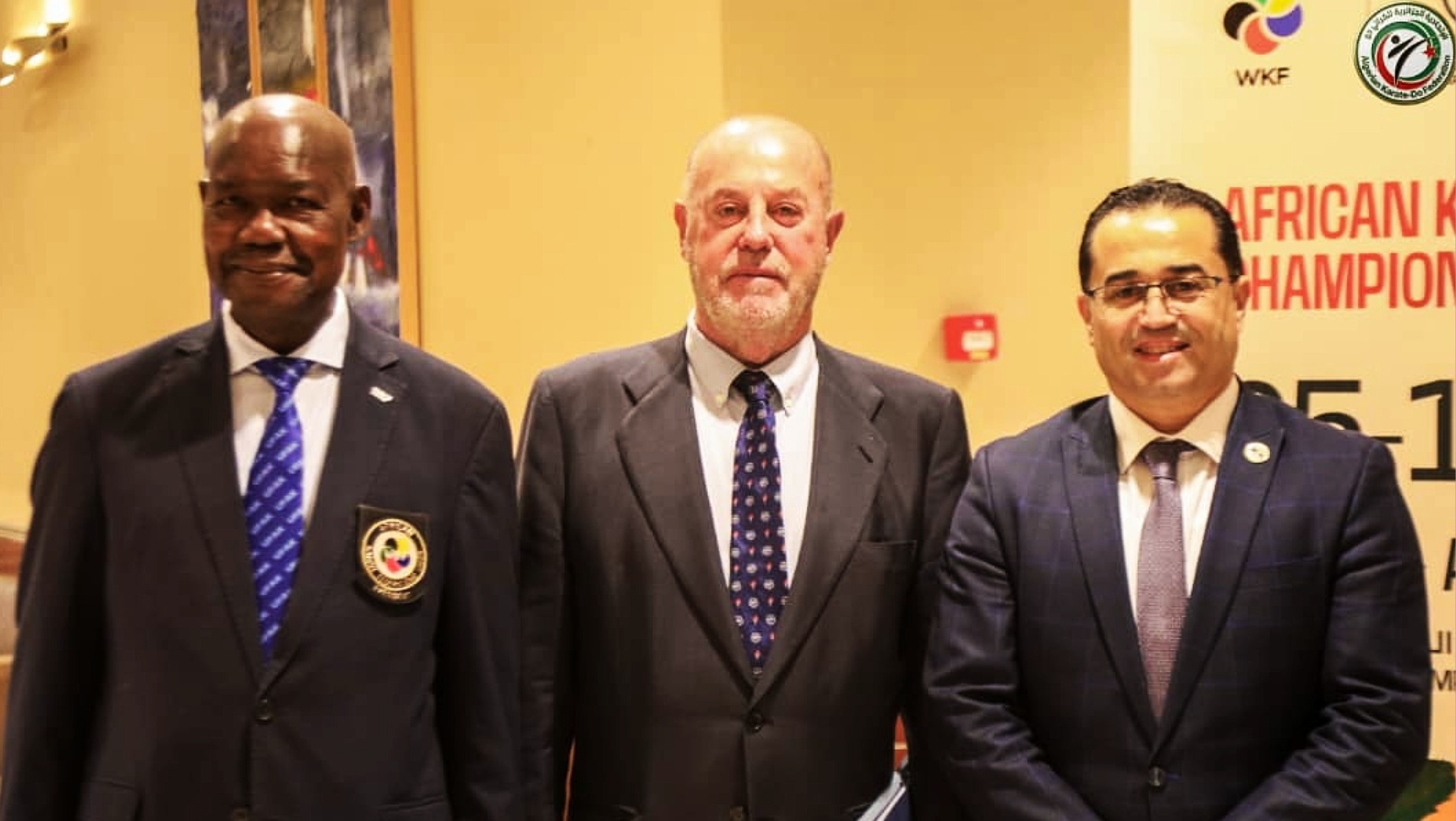
The official photograph that accompanied the WKF report of the Assembly shows Gaye, Espinós and Reda Benkaddour, president of the Algeria Karate Federation, standing together—a visual reminder that the continental meeting took place on Algerian ground, with the host National Federation visible beside the continental and world presidents. Other images from the day show Espinós addressing the plenary and standing with Cherif, and the Assembly itself in session. The pictures document presence and process rather than podium drama: a federation at work.
For African karate, the Algiers Assembly sits in a particular rhythm. Competition weeks draw the eye; General Assemblies decide whether the machinery behind those weeks is sound. Certified 2025 accounts and a provisional 2026 budget are the language of accountability. Regional programme reviews are the language of delivery. Calendar preparation for 2027 is the language of foresight. Digital development is the language of reach. Taken together, they sketch a continental federation that intends to measure itself not only by the brilliance of its athletes in a given September, but by the solidity of the structures that will still be standing when the next calendars are drawn.
Olympic prospects, as Espinós framed them, do not float free of that solidity. A strong African continental federation, in his words, is essential to karate’s future and to those prospects; unity among African National Federations is the method he named. That message lands with particular force in a year when UFAK has already placed a major championships cycle in Algiers and is looking toward a World Cup season and a 2027 calendar still being shaped. The Assembly did not invent Africa’s importance to world karate; it insisted that importance be organised, accounted for, and planned.
What remains, after the doors of the Assembly close, is the work those priorities imply: National Federations aligning with continental direction, regions turning programme reviews into sustained support for athletes, and a 2027 calendar that gives African karate a coherent place in the international year. Gaye’s chairmanship, Cherif’s regional overview, Espinós’s call for unity, and Benkaddour’s presence as host-federation president form the public face of that day. The substance is quieter and longer: governance that holds, finances that are certified and provisional budgets that are debated, and a continental federation that treats digital development and institutional strength as part of the same project as the athletes who will one day walk onto the tatami under African colours.
In that sense, Algiers on 9 September was a hinge between the championships week the public saw and the seasons the public has not yet marked on its calendar. UFAK used the hinge to set course—toward clearer governance, toward a prepared 2027, and toward an Olympic conversation in which a strong African federation is not optional scenery but essential architecture.
Sources
- WKF UFAK General Assembly Reviews African Karate Development Priorities (13 Sep 2026)
-
- Photo: wkf.net — Souleymane Gaye, Antonio Espinós, Reda Benkaddour