

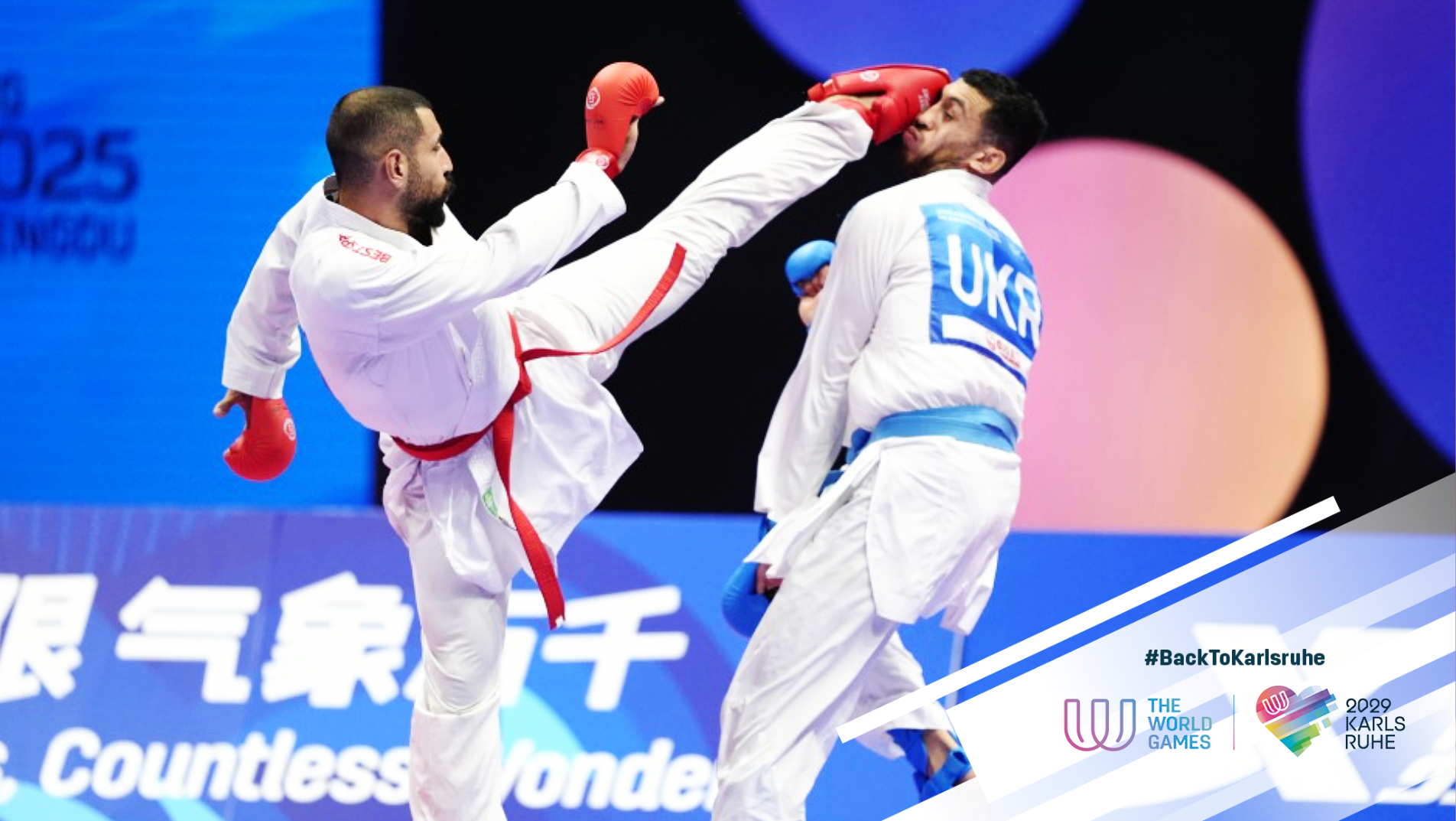
On the tatami of a German summer still three years away, karate’s place at The World Games has been written into the programme once more — and this time with a chapter that has never appeared there before. From 19 to 29 July 2029, Karlsruhe will host the 13th edition of the multi-sport event. Karate returns with kata and kumite, and, for the first time at The World Games, with Para Karate.
The confirmation arrived in two measured steps. On 3 September 2026, from Lausanne, the International World Games Association published the full sports programme and disciplines for Karlsruhe 2029. A day later, on 4 September, the World Karate Federation answered: karate is confirmed, and Para Karate will make its debut on the World Games stage.
Karlsruhe, 19–29 July 2029
The calendar is unambiguous across both institutions. The World Games 2029 run for eleven days in midsummer Germany. Karlsruhe is not a new name on that map. Forty years after it staged The World Games in 1989 — a continuity the IWGA alone underlines — the city returns as host of the 13th edition, expecting around 4,000 athletes from more than 100 countries, across 36 sports and 62 disciplines.
Those figures describe the Games as a whole, not a karate quota. Medal-event counts, qualification pathways and competition venues for karate in Karlsruhe are not yet set; the IWGA notes those layers will come later. What is locked now is the programme spine: sports, disciplines, and which karate modalities will share the floor.
A programme sealed in Lausanne
The IWGA’s September confirmation completed a process begun after its Annual General Meeting in April, when an initial sports programme was unveiled. The full list — including Host City–invited sports and sports for athletes with impairment — was finalised after approval by the IWGA Executive Committee and the Karlsruhe 2029 Organising Committee. Datelined Lausanne on 3 September 2026, the announcement fixed the architecture of the edition.
For karate, that architecture is specific. In the IWGA programme table, the sport appears with three disciplines: Kata, Kumite, Para Karate. The WKF’s wording matches: alongside kata and kumite, the programme will include Para Karate. The pairing of familiar competition forms with a modality for athletes with disabilities is the story the federation chose to lead with — not a simple renewal, but an expansion.
Kata, kumite — and a first for Para Karate
Kata and kumite remain the twin pillars of karate at The World Games: form on one side of the tatami, the contested bout on the other, athletes in karategi under officials and a global audience that has followed the sport since the Games began. Para Karate changes the frame.
According to the WKF, Para Karate brings athletes with disabilities into karate at The World Games for the first time. The modality is not new to the senior calendar — it has been on the Senior World Championships programme since 2014 — but Karlsruhe will be its World Games debut. A discipline already tested on the world championships stage now steps onto the multi-sport platform that has carried karate since the inaugural Games.
The WKF presents the move as continuity with strategy: modalities for people with disabilities have sat at the core of its planning, and inclusion at The World Games 2029 is framed as another step toward a lasting social legacy through sport. Chengdu 2025, the 12th edition, is the backdrop it cites when speaking of karate among the most followed disciplines on the programme.
Thirteen consecutive appearances since Santa Clara
Care with the numbers is part of the story. Karlsruhe is the 13th edition of The World Games. Separately, it will be karate’s 13th consecutive appearance on that programme — a streak that begins with the inaugural Games in Santa Clara, USA, in 1981 and has not been broken since. The two “thirteenths” rhyme; they do not mean the same thing. One counts editions of the multi-sport event. The other counts karate’s unbroken presence inside it.
From Santa Clara through every subsequent host to Chengdu and now Karlsruhe, karate has remained on the programme — core, popular, spectacular, in the language WKF president Antonio Espinós uses after the confirmation. Para Karate does not interrupt that line; it widens it.
Forty years after Karlsruhe 1989
The host city’s own history with The World Games adds another resonance that belongs to the IWGA record. Karlsruhe staged the Games in 1989. In 2029 it will do so again, forty years later. For an organisation that moves from city to city, a return after four decades is rare geography: the same German host, a generation apart, bookending a span in which karate itself never left the programme.
Official information for 2029 is anchored at www.twg2029.com, alongside the IWGA’s coverage of the confirmed programme. Schedules, medal events and the precise shape of Para Karate draws remain for later announcements. The sporting fact is already public: karate is in, and Para Karate is in with it.
Espinós: core sport, social legacy, Karlsruhe ahead
WKF president Antonio Espinós framed the moment in three movements — congratulation, evidence from Chengdu, and the meaning of Para Karate’s arrival:
“I would like to congratulate the entire karate family on the inclusion of our sport in The World Games 2029 for its 13th edition. Karate is not only one of the core sports on the programme; it is one of the most popular, spectacular, and thrilling sports in The World Games and one of its most followed disciplines.
“This was clearly demonstrated at the last edition in Chengdu, where karate was among the top three sports across all the social media metrics, as reflected in several studies. Now, as we move towards The World Games 2029 in Karlsruhe, we are pleased and honoured to introduce Para Karate.
“The progress of our modalities for people with disabilities has been at the core of our strategy. With the introduction of Para Karate at The World Games, the social legacy of karate is highlighted even further, and its inclusion at The World Games 2029 represents another important step in creating a lasting social legacy through sport. We look forward to seeing our karatekas and para karatekas compete in Karlsruhe and to continuing this important journey together.”
Core sport, heavily followed; Chengdu among the top three on social metrics; Para Karate as honour and strategy; Karlsruhe as the horizon where karatekas and para karatekas compete side by side.
Toward July 2029
Between Lausanne’s announcement and opening day in Karlsruhe stretch almost three years of preparation — for federations, athletes mapping a path toward 2029, and a host city that last welcomed The World Games when many of today’s competitors were not yet born. Fixed today: 36 sports, 62 disciplines, roughly 4,000 athletes, more than 100 countries, and karate with kata, kumite and Para Karate.
How many bouts, how the Para Karate field is drawn, which halls will hold the tatami — all of that waits for later releases. Early September 2026 does not invent that future; it names the destination. Karate remains on The World Games. Para Karate joins it. Karlsruhe, forty years on from 1989, will be the stage.
Sources
- WKF — Karate Confirmed for The World Games 2029 with Para Karate Making its Debut (4 September 2026): https://www.wkf.net/news-center/article/!/3271/karate-confirmed-for-the-world-games-2029-with-para-karate-making-its-debut
- IWGA / The World Games — The World Games 2029 Karlsruhe – Confirmed Sports Programme and Disciplines (3 September 2026, Lausanne): https://www.theworldgames.org/news/The-World-Games-2029-Karlsruhe-Confirmed-Sports-Programme-and-Disciplines-2815
- Official Games site: https://www.twg2029.com
- Hero image: https://www.wkf.net/files/images/news/090426_worldgames2029.png — photo credit wkf.net / WKF