
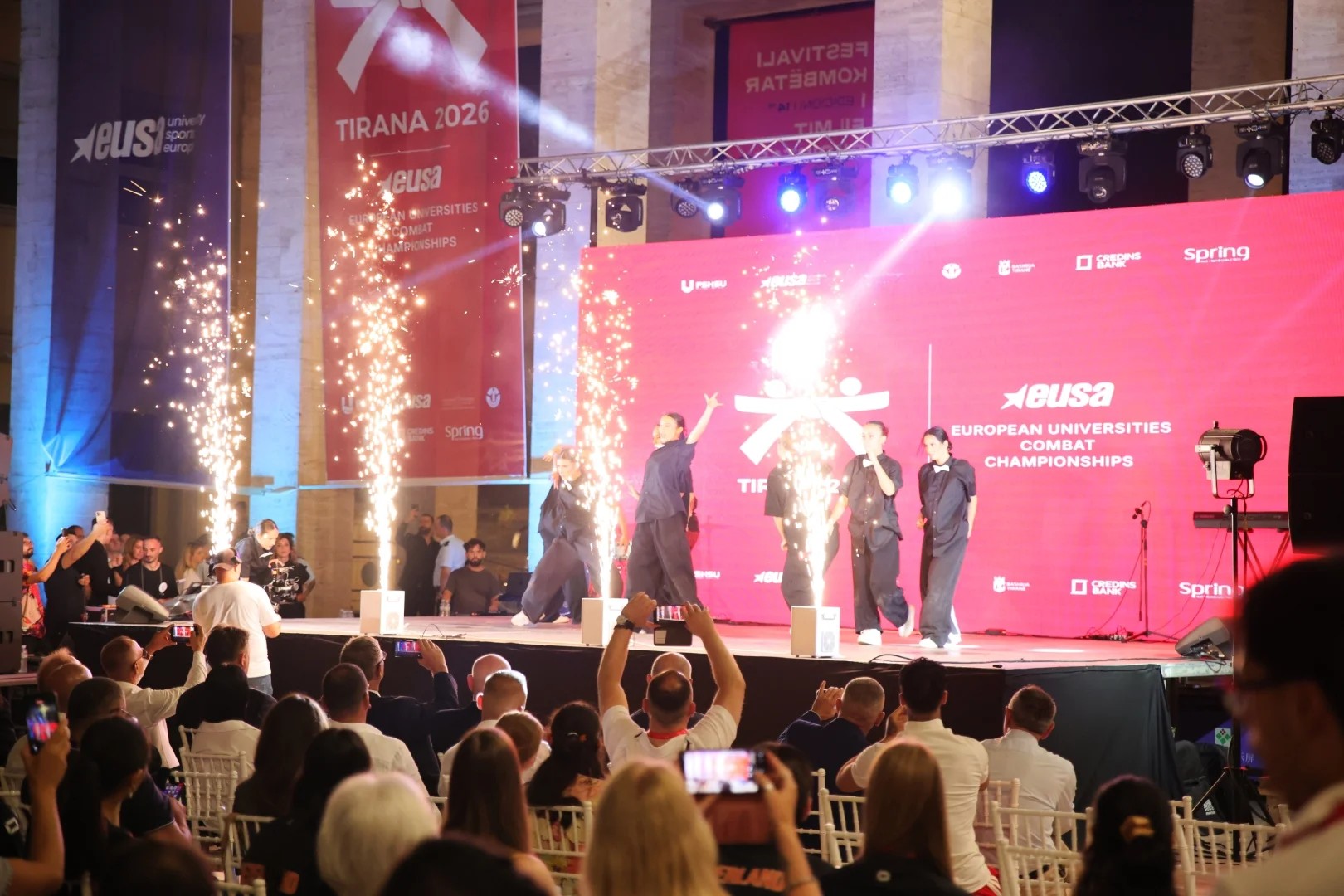
On a mild September evening in the Albanian capital, university sport unfurled across Skanderbeg Square. Flags, delegations and the red Tirana 2026 screen marked the opening of the European Universities Combat Sports Championships — an EUSA event hosted with the Albanian University Sports Federation (FSHSU). For karate, the square was only the prologue. The real story would be written on the tatami at the University of Sports of Tirana, where Block 1 of a new 2+2 championship format paired karate with taekwondo from 8 to 11 September (arrivals on the 7th, departures on the 12th). Judo and kickboxing would wait for week two. This is the karate chapter alone.
A European university championship, not a national cup
EUSA remains the event body; competition regulation sits primarily on the latest World Karate Federation (WKF) and European Karate Federation (EKF) rules, read together with the EUSA regulations for European Universities Championships 2026. That framing matters for how results should be told. Athletes compete for universities. Country codes on the results board are geography, not a licence to invent a clean national medal table — especially when the official multi-sport standings mix taekwondo into the same Combat Sports event. What follows is drawn from the EUSA results platform category by category: individual kumite for women and men across all weight divisions, individual kata, kata teams and kumite teams.
Individual kumite: weight by weight
The women’s −50 kg final set an early tone of narrow margins. Maya Schaerer of the University of Zurich edged Rabia CaliŞ of The University of Health Sciences 3–2. Bronzes went to Kubra Yazici (Manisa Celal Bayar University) and Rabia Elik (Istanbul Kent University). One division up, Marmara University’s Buse Kiliç took the −55 kg gold against Qendresa Ibrahimi of the University of Pristina; Elif Sismanoglu (Istanbul Aydin University) and Natalia Vargova (University in Trnava) shared bronze.
At −61 kg, Nurbade Buber of Manisa Celal Bayar University defeated Jovana Micovska of Saints Cyril and Methodius University of Skopje. The bronze medals belonged to Nina Radjenovic (Swiss Distance University of Applied Sciences) and Lea Marie Bosshard (University of Bern). In −68 kg, Hanna Devigili of the University of Linz controlled the final against Melisa Kurdoglu of Marmara University, with Sara Krivdova (Matej Bel University) and Madeleine Schroeter (Friedrich-Schiller-University Jena) on the third step. The open weight closed with authority: Vlere Qerimi of the University of Pristina blanked Niamh Junner of Glasgow Caledonian University 3–0 in +68 kg; Fatma Uygur (Istanbul Aydin University) and Selina Stamer (Dresden University of Technology) took bronze.
Men’s kumite stretched from the lightest to the heaviest categories with equal clarity. Mert Halicı of Marmara University claimed −60 kg over João Ribeiro of the University of Minho; Aleksander Opas (Poznan University of Technology) and Enzo Falco (University of Grenoble Alpes) earned bronze. The −67 kg final was an all-Turkish university duel decided by a single point: Ekrem Altuner Yilmaz of Istanbul Kent University 9–8 over Muhammed Hamza Onur Yazici of Bursa Uludag University, with bronzes for Ahmet Ozturk (Istanbul Aydin University) and Mihajlo Zrinic (Aperion University).
At −75 kg, Luka Pejic of the University of Banja Luka won the gold medal match against Omer Faruk Yurur of Istanbul Aydin University; Mustafa Islam Ogragli (also Istanbul Aydin) and Martin Ciaky (Matej Bel University) took bronze. Host-nation drama arrived in −84 kg: Melos Gashi of University Fan Noli defeated Sinan Paljevac of the University of Sarajevo 7–6, while Ashton Patrick (University of Nottingham) and Hamza Turulja (University of Sarajevo) shared bronze. In +84 kg, Toni Cutura of the University of Zagreb prevailed over Kadir GenÇ of Istanbul Aydin University; Srdjan Jovanovic (University of East Sarajevo) and Tomas Kosa (Comenius University) completed the podium.
Kata: individuals and teams
Kata day gave the championship its other grammar — flags, timing and, in the team event, bunkai from the semi-finals. Elena Roversi of the University of Ferrara won the women’s individual final 5–2 against Natacha Fernandes of the University of Lisbon; Maria Cardoso (University of Porto) and Ines Oliveira (University of Lisbon) took bronze. Adam Bardos of IE University edged Roman Hrcka of the University of St. Cyril and Methodius 4–3 for the men’s title, with Joao Vieira (Polytechnic Institute of Porto) and Emre Vefa Goktas (Istanbul Kent University) on bronze.
Team kata underlined how concentrated university programmes can still travel. Istanbul Aydin University won the men’s team final 7–0 against Poznan University of Technology in a two-team gold-medal match. In the women’s team final, the schedule board recorded Istanbul Aydin University against the University of Porto at 0–7 with the win marked for Porto; bronze medals went to the University of Nottingham and Istanbul Kent University. (The category’s published FINAL RANKING table on the results site conflicts with that gold-medal match and with secondary reports that list Aydin as silver — the match result is the reading used here.)
Team kumite: Pristina and Sarajevo
Team kumite rewarded collective depth. The University of Pristina defeated the University of Linz 11–6 for the women’s team gold; Istanbul Aydin University and Manisa Celal Bayar University took bronze. On the men’s side, the University of Sarajevo beat the University of Nottingham 2–1 in the final, with Istanbul Kent University the sole bronze listed on the official final ranking.
What the week said — and what it did not
Across sixteen karate categories, the map of gold was European in the university sense of the word: Zurich and Ferrara, Marmara and Istanbul Kent, Banja Luka and Zagreb, Linz and Pristina, Fan Noli in the host city, IE University, Sarajevo, Istanbul Aydin, Porto. Turkish universities collected five of those golds — Halicı, Kiliç, Yilmaz, Buber and the Istanbul Aydin men’s kata team — a tally that aligns with official finals even when secondary national press packages (sometimes citing twenty-one karate medals) should be treated as secondary colour rather than EUSA accounting. Prefer the university line every time.
The same caution applies to the all-sports Combat Sports medal standings on the EUSA results site: they are not a karate-only table. Taekwondo shared Block 1; judo and kickboxing still had their own week to come. For karate.news readers, the clean story is simpler. Europe’s university karate opened the Tirana Combat Sports week on official tatami, under WKF/EKF rules inside an EUSA championship, and left a complete set of podiums worth reading university by university.
Sources
- https://combatsports2026.eusa.eu/
- https://combatsports2026.eusa.eu/competition/karate
- https://www.eusa.eu/tirana-to-host-euc-combat-sports-2026
- https://results.eusa.eu/index.php?page=index&sport=12&multi=137&ln=en
- Category summery pages ids 12741, 12749, 12733, 12813, 12729, 12701, 12687, 12767, 12677, 12693, 12711, 12685, 12697, 12689, 12753, 12691