
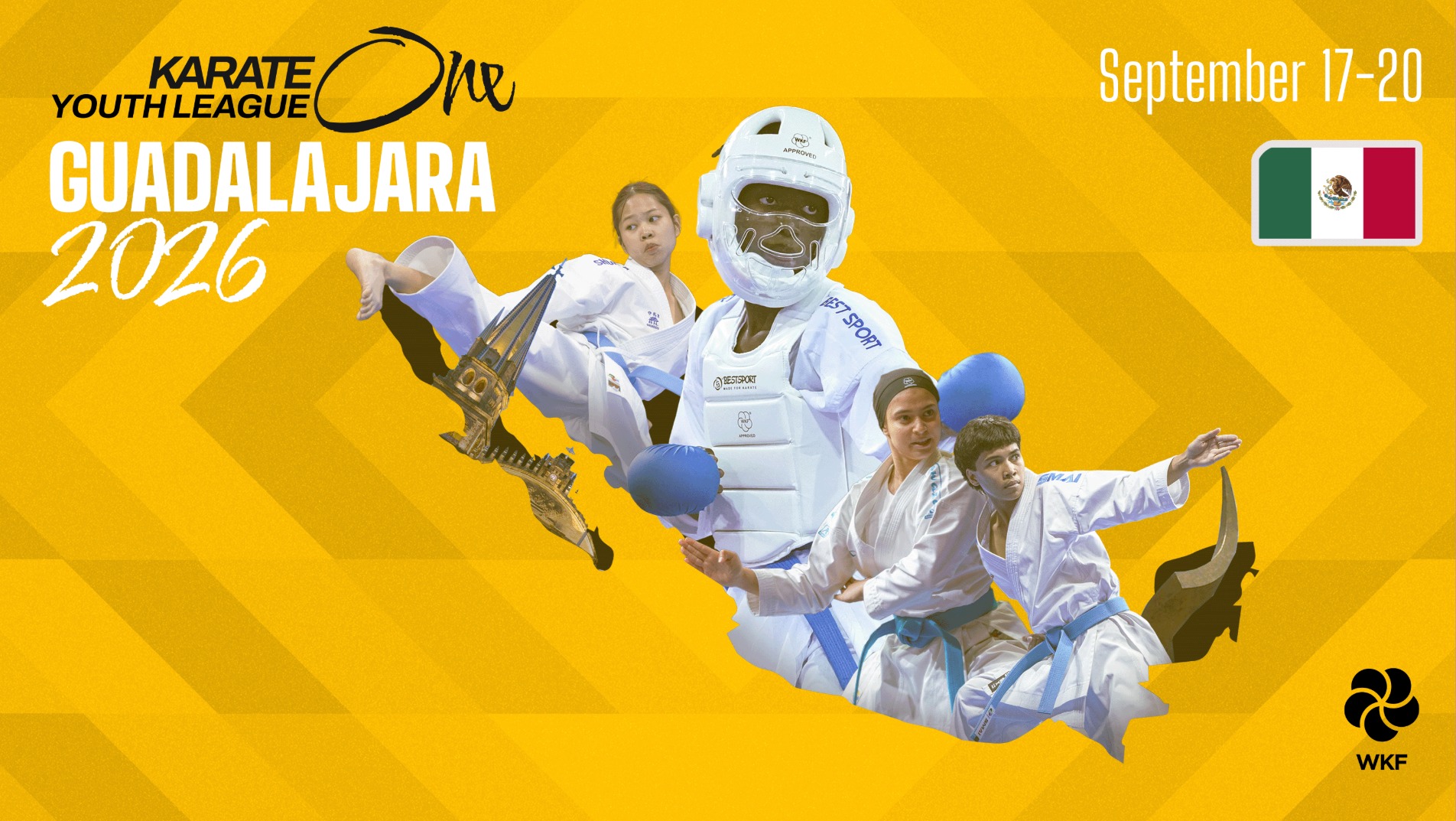
Guadalajara opens the fifth chapter of the 2026 Karate One Youth League on Thursday 17 September, and the calendar already tells a story of range. After Fujairah in the United Arab Emirates, Harare in Zimbabwe, Manila in the Philippines and Poreč in Croatia, the series lands in western Mexico for four days that matter less as a scoreboard than as a checkpoint in the sport's youth pipeline. The season will close later in Venice, Italy. Between those bookends, Guadalajara is the Americas stop — where more than five hundred athletes from thirty-seven countries, aged twelve to seventeen, step onto the tatami under the World Karate Federation's youth circuit.
After the continental week already covered on karate.news in Algiers, the global September map turns again toward the Karate One Youth League. WKF's briefing of 16 September 2026 frames Guadalajara as another gathering of emerging talent: competition, ambition and the future of karate in one hall, with finals closing each day from Thursday through Sunday.
Fifth stop, not a side note
The Karate One Youth League sits under the Karate One umbrella as a dedicated stage for ages 12 to 17. WKF describes it as a platform for youngsters progressing in the sport and as a way to show karate's impact early, before senior Premier League lights take over the conversation. Thirty-four categories, kata and kumite, knockout format: the architecture is simple and demanding. There is no soft landing for a first bout against an international draw. That is the point of a Youth League stop — density of opposition, clarity of age bands, and a public stage that treats U14, Cadet and Junior cohorts as athletes in formation, not as a footnote to the elite calendar.
Guadalajara is the fifth event of this landmark 2026 season. The sequence already spans four continents before Mexico. Venice will seal the year. This is not an isolated Mexican tournament that happens to carry a Youth League logo. It is a scheduled node in a global youth season — the Americas chapter after Asia, Africa and Europe have already hosted.
Mexico's uninterrupted youth hub
Mexico did not become a Youth League destination by accident. WKF states that the country has hosted Karate One Youth League events uninterruptedly since 2022, and that Mexico has become one of the main hubs of youth karate in the world. The recent trail is clear: Monterrey 2025, Cancún 2024, Mérida 2023, Acapulco 2022. Earlier editions reached Monterrey in 2019 and Cancún in 2018. Guadalajara 2026 continues that chain in a new city, still inside the same national continuity.
For coaches and national programmes, that continuity matters as much as any single podium. A federation that can plan annual Youth League travel into Mexico knows the competitive temperature of the circuit. Athletes who return year after year meet different hosts but the same series logic: age-band caps, knockout pressure, live visibility. Guadalajara inherits that reputation before the first bow.
Polideportivo CODE López Mateos
Competition runs at the Polideportivo CODE López Mateos in Guadalajara. Spectator entrance is free. The official schedule also places the venue in the Complejo Panamericano de Gimnasia frame and lists Avenida Cristóbal Colón in the Colón Industrial district — useful on the ground, secondary to the sporting fact that a major youth field will compete in a municipal complex with open doors for the public.
Four days, 17 to 20 September. Competition starts on Thursday and continues until Sunday. Finals are held at the end of each competition day. That daily cadence — eliminations and repechages building toward an evening medal window — is the spectator's clock as much as the athlete's. Free entry lowers the barrier between the city and the tatami. Youth League karate becomes visible where it belongs: in front of families, clubmates and anyone who walks in to see what the next generation looks like under pressure.
Five hundred athletes, thirty-seven countries
Registration already sits above 500 athletes from 37 countries. The field is open to ages 12–17 across U14, Cadet and Junior bands, in kata and kumite, across 34 categories. Capacity rules keep the brackets from exploding. In kumite, Junior and Cadet categories are capped at a maximum of 96 athletes each; U14 kumite at 64. In kata, Junior and Cadet rise to a maximum of 128 per category; U14 kata stays at 64. Those ceilings keep a youth circuit competitive without becoming unmanageable — enough depth for a true knockout draw, enough restraint to protect the quality of the day.
The format is knockout throughout. Every early exit is final in the elimination tree until repechage paths reopen medal chances where the rules allow. For a twelve-year-old in U14 or a seventeen-year-old Junior chasing a final, the emotional temperature is the same: one bout at a time, on international tatami, under WKF rules.
Thursday opens with Junior kata and kumite
The published competition schedule gives Thursday a clear Junior spine. Day 1 — Thursday 17 September — carries eliminations and repechages in Junior individual kata for men and women, then Junior individual kumite in the men's −55, −76 and +76 categories and the women's −66 and +66, before Junior finals close the day. The schedule lists a morning start at 09:00. WKF notes that the final programme can still be adjusted after online registration closes to match definitive entry numbers. What is firm for preview purposes is the season-level frame: Thursday start, finals at the end of each day, and a Junior-led opening on the Guadalajara tatami.
Why the Youth League still matters
Senior calendars absorb headlines. Youth League stops absorb futures. Between Fujairah and Venice, Guadalajara is where a season's fifth chapter asks whether a Cadet who looked sharp in Manila can hold form in Mexico, whether a Junior kata specialist can survive a 128-cap field, whether an U14 athlete discovers international rhythm for the first time. The answers will arrive in live bouts. What a preview can hold is structural and true: the series is built for that discovery, Mexico has proven it can host it year after year, and WKF is putting the whole event full and live on its YouTube channel so the pipeline is not only for those inside the hall.
Karate's next senior names will not all come from one continent or one academy. They will come from seasons like this — multi-stop, multi-city, age-banded, knockout-hard — in which Guadalajara is neither the beginning nor the end, but the Americas hinge of 2026. From Thursday to Sunday, Polideportivo CODE López Mateos holds that hinge with free spectator access and a field already counted in hundreds. Venice waits. First, Mexico opens again.