
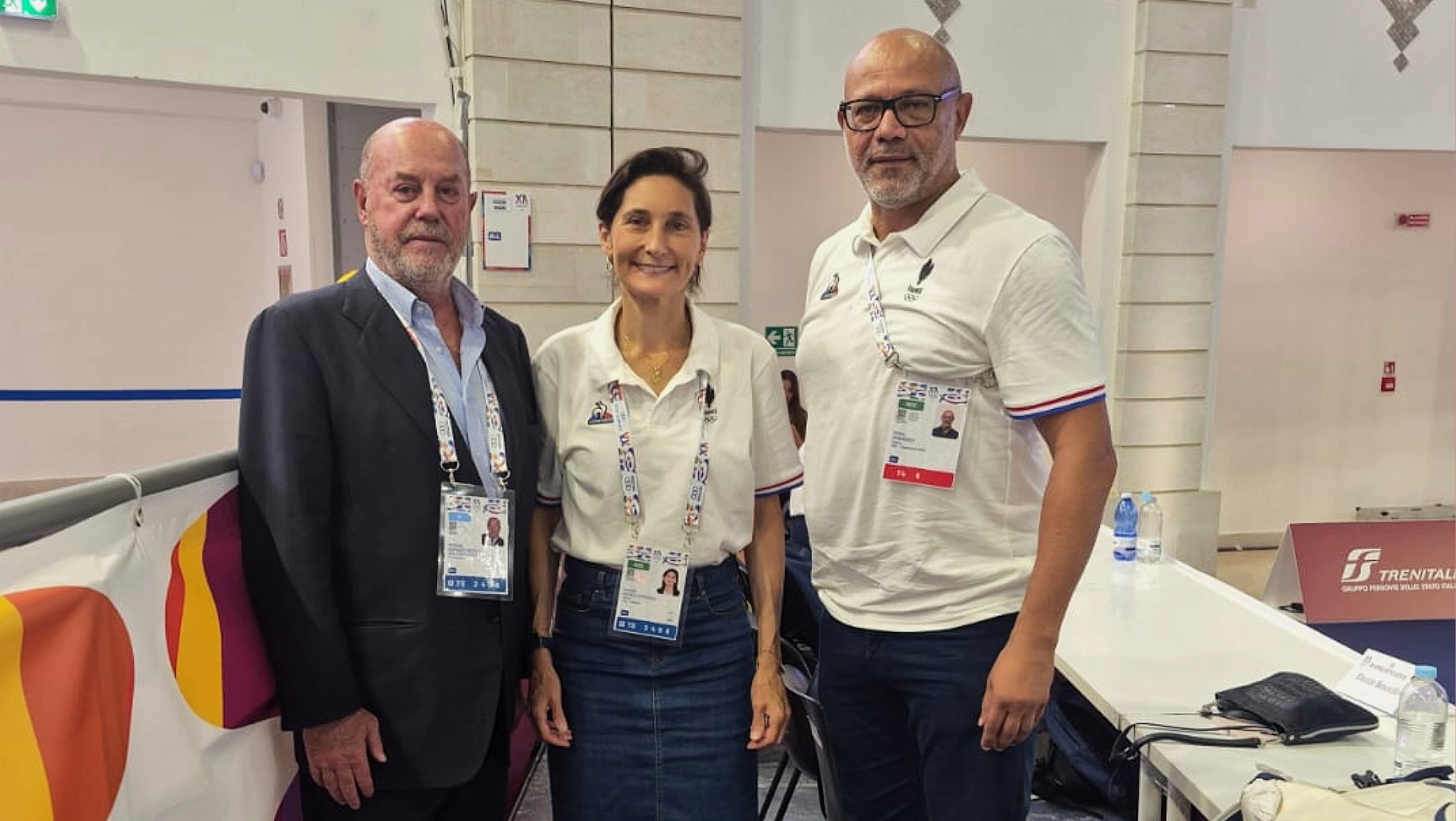
On the second and final day of karate at the 2026 Mediterranean Games in Taranto, the story on the tatami was medals and closing bouts. Alongside it, another scene took shape: an institutional encounter the World Karate Federation placed at the centre of its news cycle. Antonio Espinós, President of the WKF — and, in the Federation’s photo caption, WKF and EKF President — met Amélie Oudéa-Castéra, President of the French National Olympic and Sports Committee (CNOSF). Gilles Cherdieu, President of the French Karate Federation (FFK), also attended.
The WKF published the account on 3 September 2026. It named no room, no clock time, no signed list of outcomes. What it recorded is the frame, the participants, the topics reviewed, and Espinós’s voice — the only full quotations the Federation attributed.
Three presidents on the Mediterranean Games stage
The photograph that heads the release lines them up from left to right: Espinós, Oudéa-Castéra, Cherdieu. Titles are careful. Espinós appears as WKF and EKF President; Oudéa-Castéra as CNOSF President; Cherdieu as French Karate Federation President. The setting is Taranto; the calendar is the closing day of Mediterranean Games karate. That is the stage the Federation offers — not a bilateral locked in an unnamed suite, but a meeting dated to the same day the kumite programme in Puglia reached its end.
For an international audience, the composition matters as much as the names. A world federation president, a national Olympic committee president and a national karate federation president share a frame on a multi-sport event’s karate closing day. The Mediterranean Games are not the Olympic Games; they remain a recognised multi-sport stage for karate’s competitive appeal. The WKF makes that link when it describes Oudéa-Castéra’s presence at the competition.
France, worldwide development, Marseille 2027
According to the Federation, the meeting offered an opportunity to review the development of karate worldwide, with particular attention to the sport’s strong position in France. France, in the WKF’s framing, ranks among the world’s leading karate nations: a large community, strong presence at all levels, an important role in international development, one of the biggest and most active markets, and a host of successful events. The narrative then points forward: next year it will welcome the 2027 EKF Senior Championships in Marseille.
That sentence is institutional geography, not a results bulletin. Marseille 2027 sits on the European senior calendar under the EKF — the continental body Espinós also leads in the WKF caption — in a country the Federation already calls central to the sport’s global map. The piece does not invent contracts or side deals. It places Marseille on the same line as worldwide development and France’s standing: a host date already named, a year away.
Olympic language appears in Espinós’s own words, not as a joint declaration. The article does not claim programme decisions, does not name Los Angeles 2028, and does not attribute endorsements to the CNOSF or the FFK. What it attributes is discussion — of Olympic prospects and of efforts to strengthen karate’s position within the Olympic Movement — and a reading of dialogue between the WKF, the French Olympic movement and the French Karate Federation.
Espinós: thanks, progress, Olympic prospects
The Federation publishes two passages in Espinós’s voice. The first thanks the CNOSF President for being in the hall and sets the meeting’s substance as he presents it:
“I would like to thank Amélie Oudéa-Castéra for taking the time to visit the karate competition in Taranto. I am pleased we had the chance to share the progress of our sport around the world and in France. I am also delighted that we had the chance to discuss the Olympic prospects of karate with Mrs Oudéa-Castéra, as well as our continued efforts to strengthen the sport’s position within the Olympic Movement.”
Progress worldwide and in France; Olympic prospects; continued efforts inside the Olympic Movement. The verbs are share and discuss. They do not announce a decision. That restraint is part of the news: a WKF president using the closing day of Mediterranean Games karate to place France’s Olympic committee leadership inside a conversation the Federation wants the wider Movement to hear.
A CNOSF President at the competition
Separately, the WKF states that Mrs Oudéa-Castéra attended the karate competition in Taranto, where she witnessed the action first-hand and saw the values and competitive appeal of karate as part of a major multisport event. Espinós’s first quote mirrors that claim when he thanks her for visiting. Neither line invents a courtside itinerary or a personal reaction from her. There is no quotation from Oudéa-Castéra in the WKF article; karate.news does not supply one.
Attendance, in this institutional reading, is itself a signal. A national Olympic committee president watching kumite at a Games-scale event is presented as evidence of the sport’s place in the French sporting landscape, not as a medal-table footnote.
Dialogue with the French Olympic movement and the FFK
The second Espinós passage turns from thanks to architecture:
“The presence of the CNOSF President at the karate competition underlined the importance of the sport within the French sporting landscape and provided an opportunity to further strengthen dialogue between the WKF, the French Olympic movement, and the French Karate Federation.”
Here the triangle is named: WKF, French Olympic movement, French Karate Federation. Cherdieu’s presence anchors the national federation side; Oudéa-Castéra’s titles and attendance anchor the Olympic committee side; Espinós speaks for the world body — and, by caption, for the European federation as well. The WKF publishes no statement from Cherdieu. The claim that travels is Espinós’s: presence underlined importance; the moment was an opportunity to strengthen dialogue.
Read against the rest of the release, that dialogue sits next to three concrete WKF claims: France’s strong position in world karate; Marseille’s hosting of the 2027 EKF Senior Championships; and a conversation, attributed to Espinós, about Olympic prospects and the sport’s place in the Olympic Movement. No further outcome is stated. The institutional news is the meeting itself, on closing day in Taranto, with those themes on the table and those two passages as the only full quotations.
Athletes in karategi and the rhythm of kumite finals belong to the competition file published the same day. This feature stays with the people in the photograph: Espinós, Oudéa-Castéra, Cherdieu; WKF, CNOSF, FFK; Taranto now, Marseille next year — Olympic language only where the Federation placed it. Venue, exact hour and mutual commitments remain unstated.
Sources
- WKF — WKF President Antonio Espinós Meets CNOSF President Amélie Oudéa-Castéra in Taranto (3 September 2026): https://www.wkf.net/news-center/article/!/3270/wkf-president-antonio-espinos-meets-cnosf-president-amelie-oudea-castera-in-taranto
- WKF — Three More Champions Crowned as 2026 Mediterranean Games Karate Competition Concludes in Taranto (3 September 2026): https://www.wkf.net/news-center/article/!/3268/three-more-champions-crowned-as-2026-mediterranean-games-karate-competition-concludes-in-taranto
- Hero image: https://www.wkf.net/files/images/news/090326_wkfpresident_pres_cnosf.jpeg — photo credit wkf.net / WKF