
On Sunday 6 September 2026, at the headquarters of Jordan’s Ministry of Youth in Amman, the last institutional stretch before Asia’s youth continental opened in earnest. Raed Adwan, Minister of Youth and chair of the Higher Organizing Committee for the 24th Asian Cadet, Junior and U21 Karate Championships, received Antonio Espinós, President of the World Karate Federation (WKF), together with continental and regional leadership already in the capital. Petra’s English wire, timed that evening, framed the encounter as a review of final operational preparations to host the delegations, athletes and committees about to fill the city.
This is not another calendar preview. The September stack has already been mapped elsewhere. What matters on the eve is the room itself: a host minister, a world federation president, Asian and Arab–West Asian presidents, and the Jordan Karate Federation’s own leadership, closing the diplomatic and organisational loop before the first weigh-ins and the first cadet bouts.
The ministry table: WKF, AKF and Arab–West Asian leadership
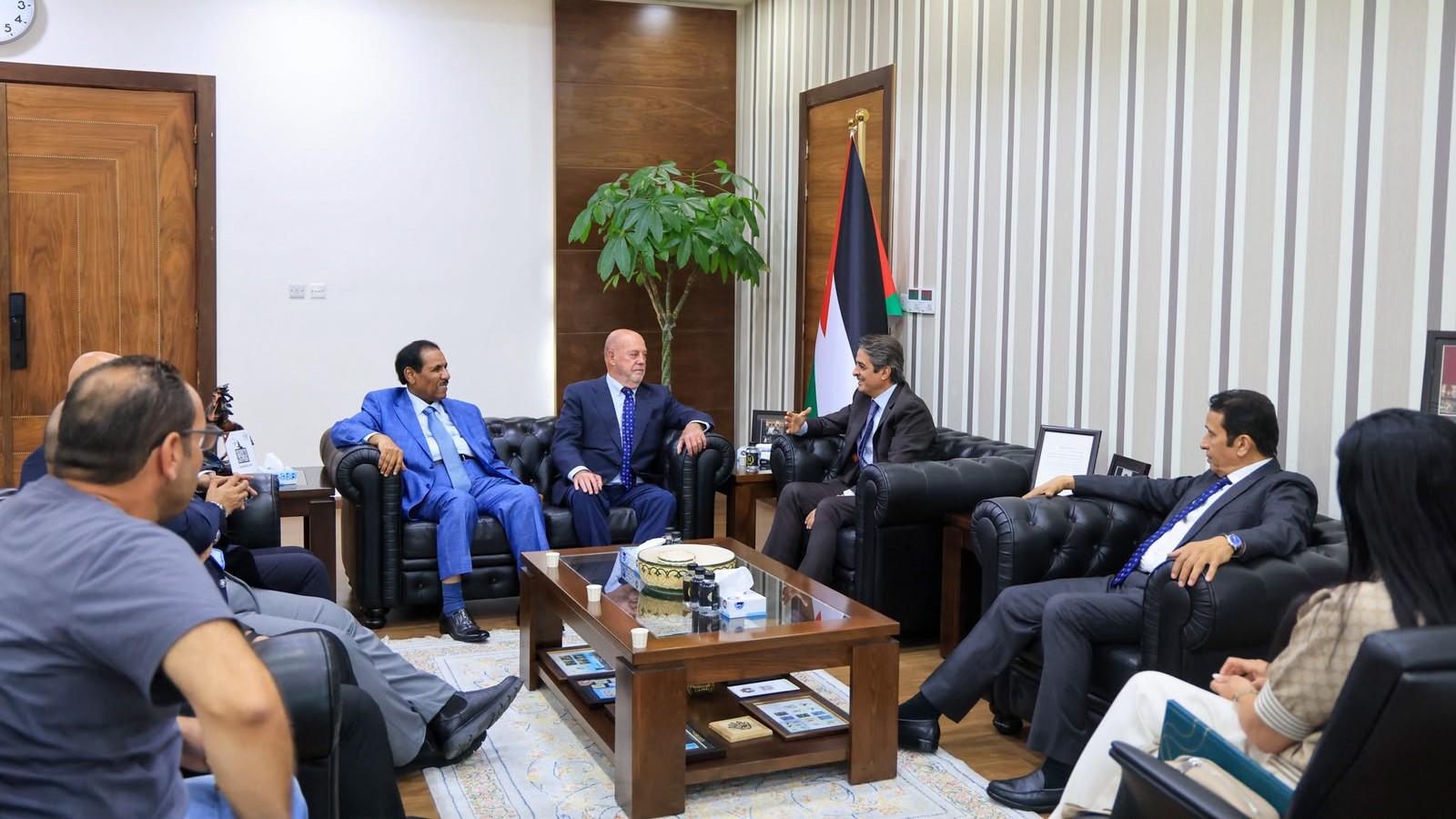
Around Adwan sat a compact institutional map of the event. Beside Espinós, Petra and Ammonnews name Maj. Gen. Nasser Al-Rzouqi (also rendered Al-Razouqi), President of the Asian Karate Federation (AKF) and, across the host briefs, WKF Vice President; Ibrahim Al-Qannas, President of the Arab and West Asian Karate Federations; Rashid Al-Ali, AKF Vice President; and, present for the reception, Hassan Masoud, President of the Jordan Karate Federation.
A youth continental championship is never only a competition file: it is a chain of governance from hosting ministry and national federation through the continental body to the world federation. Amman’s ministry headquarters made that chain visible in a single frame — the reception Petra illustrated with its official meeting photograph.
An earlier Petra brief, dated 1 September, had placed Espinós’s arrival in Amman for the following Saturday — 5 September — and had expected Al-Rzouqi and Al-Qannas with him. The Sunday meeting sits cleanly inside that arrival window. Al-Ali’s presence at the ministry table, recorded in the 6 September wires, was not named in that earlier arrival note; the eve brief simply enlarges the organisational cast once the delegation is on the ground.
Patronage and the host’s reading of confidence
Adwan’s public line, as paraphrased by Petra, tied the championship to royal Olympic patronage without inventing a royal appearance at the ministry. Hosting under the patronage of HRH Prince Feisal bin Al Hussein, President of the Jordan Olympic Committee, he said, demonstrates the AKF’s confidence in Jordan’s organisational capabilities and highlights the Kingdom as a safe destination able to host major continental and international sports events.
That is the host’s framing, not a separate palace communiqué. No source places Prince Feisal in the meeting room; the claim that travels is patronage as signal — confidence in the organiser, safety as a hosting argument, Amman as a venue of continental and international scale. The Higher Organizing Committee chairs from the Ministry of Youth; Olympic-committee patronage sits over the championship.
Praise without invented speech
Neither Petra’s English wire nor Ammonnews’s Arabic corroboration supplies a verbatim quotation from Espinós in quotation marks. What they allow is a careful paraphrase of the visiting side’s tone. Espinós and the accompanying delegation praised the advanced level of preparations, emphasising the tournament’s role in promoting sports exchange and strengthening the global profile of karate. Ammonnews carries the same beat: praise for the interest and advanced preparations, and stress on exchanging expertise among countries and reinforcing karate’s international presence.
No further words are attributed here to Espinós, Al-Rzouqi, Al-Qannas, Al-Ali or Masoud. The diplomatic news is the meeting, the purpose, Adwan’s patronage line, and that shared praise of readiness — not a fabricated speech on the edge of the tatami.
From the ministry to Al Hussein: dates, venue, field
Competition itself is framed by the WKF event page and the official championships bulletin as 8–11 September 2026, under the public tag #KarateAmman2026. Oman Observer’s 6 September despatch uses the same 8–11 September window. Petra’s 1 September national-teams brief, by contrast, cites 8–10 September — a shorter host-side end date already flagged in the live calendar preview and not settled here. Lead with the WKF and bulletin window; record the Petra discrepancy without pretending to adjudicate the final day.
On venue, Petra names the Arena Complex in Al Hussein Youth City, Amman; an earlier Oman Observer prep piece says Arena Hall in the same complex; the WKF bulletin’s extracted championship-venue line remains generic. The concrete host-side naming retained here is Petra’s Arena Complex. The bulletin’s weigh-in cadence — cadets on 7 September, juniors on 8 September, U21 on 9 September, all at the Championship Venue — is the operational spine waiting just beyond the ministry meeting.
Scale, as published ahead of the open: Petra’s early September snapshot puts the field at roughly 350 male and female athletes from 30 countries; Oman Observer’s eve despatch says 351 from 30 Asian countries — the same estimate band. Jordan’s host squad, per Petra, fields 40 athletes across 38 kumite categories. A referees’ course under AKF supervision, with around 95 local, Arab and Asian officials for rules updates and promotion exams, runs alongside. Petra’s named roll stretches from West Asia through East and Central Asia; this piece invents neither start lists nor medal forecasts.
Oman on the ground: one national colour on the eve
While the ministry meeting closed the diplomatic stretch, national teams were already in the capital. Oman Observer reported the Omani squad’s arrival ahead of the championships, citing the same 351 / 30 estimate. Four kumite athletes travel: Sharifa al Shabibi, Mohammed al Shabibi, Mukhtar al Omari and Al Yaqzan al Abdali, under international coach Ali bin Said al Shabibi, with Ahmed bin Said al Zakwani as delegation head.
Al Shabibi’s published line is direct: “The players showed great commitment and seriousness throughout the preparation period, and we are looking to deliver a performance that reflects the development of karate in Oman.” Al Zakwani’s matches it: “Our national team’s participation represents an important stage in gaining experience and exposure to top athletes across the continent. We are looking forward to delivering performances that reflect the progress of karate in Oman.” Seven Omani referees accompany the programmes — Yousef al Siyabi, Hilal al Abdali, Mohammed al Hinai, Adil al Hinai, Tariqal Raisi, Khalifa al Rasbi and Zulfa al Kindi — colour that sits beside, not above, the ministry story.
The open is next
By the WKF’s competition window, the story leaves the ministry for Al Hussein Youth City: karategi on the tatami, cadet weigh-ins already on the bulletin’s calendar for the day before the opening date, juniors and U21 following in step. Until then, the verified picture on the eve is organisational and diplomatic — Adwan chairing the Higher Organizing Committee’s final review; Espinós and the AKF and Arab–West Asian leadership in the room; Prince Feisal’s patronage invoked as a signal of confidence; preparations praised without inventing speech; and a continental youth field of some 350 athletes from about thirty countries about to step onto Jordanian tatami under #KarateAmman2026.
Sources
- Petra — Youth Minister reviews final preparations for 24th Asian Youth Karate Championship (6 Sep 2026)
- Petra — National Karate Teams Ready for Asian Youth Championships (1 Sep 2026)
- WKF — 2026 AKF Cadet, Junior & U21 Championships Amman
- Oman Observer — Oman karate team ready for Asian championships in Amman (6 Sep 2026)
- Featured image:
/workspace/featured-amman-eve-petra-meeting.jpg— photo credit Petra / Jordan News Agency (official meeting reception, 6 Sep 2026)