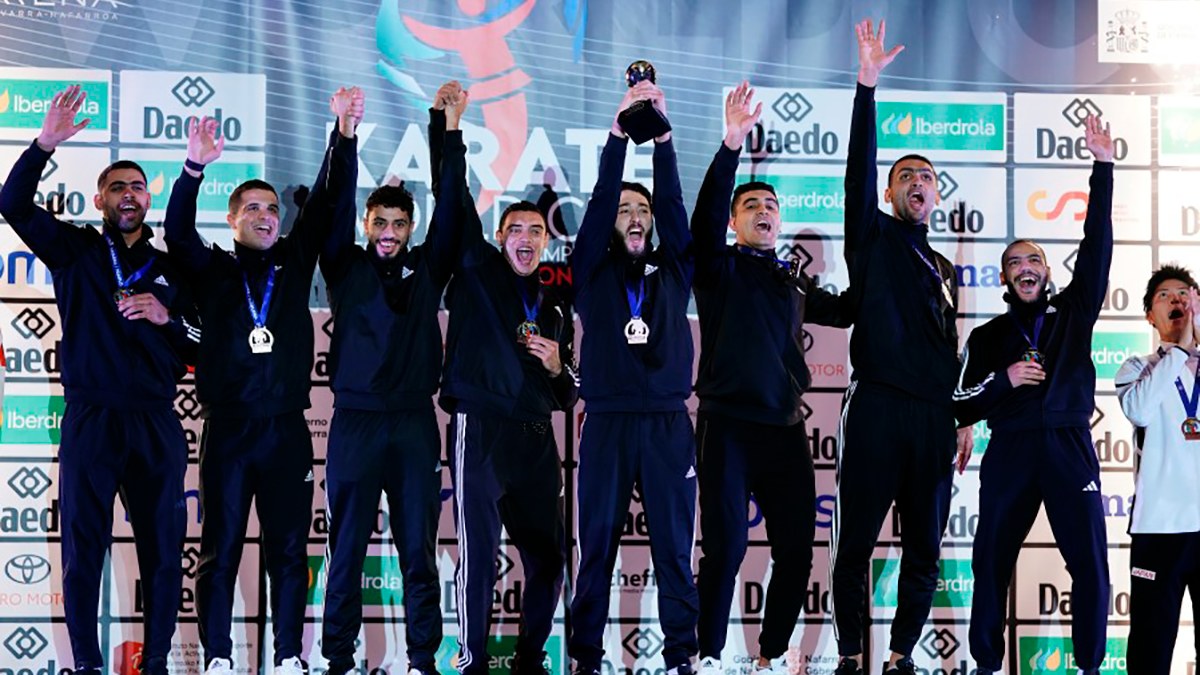


On Wednesday 9 September 2026, the AKF Cadet, Junior & U21 Championships shifted their Amman programme from cadets to U21 kata and junior kumite. At the Arena Complex in Al Hussein Youth City, the Asian Karate Federation's youth continental — running 8–11 September under #KarateAmman2026 — crowned twelve more champions. When the World Karate Federation published its Day 2 wrap on 10 September, the storyline that rose without a fabricated medal table was clear: Jordan and the United Arab Emirates stood among the nations with multiple victories, while Malaysia, Saudi Arabia, Thailand, Iran and Palestine also reached the top of the podium.
Day 1 had already given Iran the early lead among Asia's cadets, with Jordan, Saudi Arabia, Chinese Taipei, Thailand and Kuwait interrupting that pace. Day 2 asked a different question of the same week: which federations would convert junior and U21 chances on home and away tatami. Japan — gold leader at Shaoguan 2025 — remains absent from this Amman edition; that story belongs elsewhere. What the second day delivered was concrete, public and continental.
Host Jordan fills the junior board
Home gold arrived four times, all in junior kumite. Mohammad Al Najjar opened the Jordanian haul in the male weight category −61 kg, defeating Yu-En Pao of Chinese Taipei in the final — a host title that lit the Arena Complex for the second consecutive competition day. Lara Darwish followed in the female weight category +66 kg, overcoming Saghar Jandaghi of Iran. Hatem Alharasees then took the male weight category −68 kg against Fahad Alazemi of Kuwait. Hala Ghannam closed the Jordanian sequence in the female weight category −59 kg, beating Roza Rezaei of Iran.
Four host titles on a single programme day do more than decorate a home scoreboard. They place Jordan — already among the densest squads on the published Amman field — at the centre of the junior conversation rather than only in the entry list. Two of those finals ran against Iran; one against Chinese Taipei; one against Kuwait. The pattern is West Asian pressure meeting a home crowd that finally had junior names, not only cadet ones, to cheer.
UAE: U21 male kata, then junior −48 kg
If Jordan owned much of the junior kumite narrative, the United Arab Emirates wrote a clean double across disciplines. In U21 male kata, Rami Fawzi Abu Al-Haija Kareem defeated Hishamadi Muhammad Arif Hafizi of Malaysia to become the first U21 male kata champion of these championships. Later, Habiba Khalil claimed the junior female weight category −48 kg, beating Ho Cheok In of Macau, China.
Kata gold and kumite gold on the same day is a federation statement, not a coincidence of draw. The UAE left Day 2 among the nations the WKF wrap listed with multiple victories — alongside Jordan — and with proof that Emirati youth pathways can convert both the forms board and the lighter women's kumite lane.
Malaysia's U21 female kata answer
Malaysia answered on the same U21 kata board. Donny Ivy Olivera won the U21 female kata title, defeating Baharijavadhesari Ailin of Iran in the final. Olivera's gold gave Malaysia its first U21 kata title of the event; the silver of Hafizi in the men's final kept Malaysian names on both U21 kata podiums.
That pairing matters. A federation that reaches both U21 kata finals on the day the first U21 individual titles are decided is not a footnote to West Asian kumite. It is a Southeast Asian thread — precision work against Iranian and Emirati pressure — that Day 2 made visible without inventing a medal table.
West Asian rivalry in the middle and heavy lanes
Around Jordan's four golds, the junior kumite programme kept drawing West Asian finals. Abdulrahman Arafat of Saudi Arabia took the male weight category −55 kg against Gurbannazar Amandurdyev of Turkmenistan. Amro Albargawi, also of Saudi Arabia, won the male weight category +76 kg by defeating Hassan Elsheikh of Qatar. Iran's junior answer came through Setayesh Ghanei Fard, who claimed the female weight category −53 kg against Ramah Khayyat of Saudi Arabia — Iran's first junior kumite gold of the day, after a Day 1 that had already put Iranian cadets at the front of the week.
Iran also reached several other finals and left Amman Day 2 with silver in U21 female kata, in the junior female weight categories +66 kg, −66 kg and −59 kg, and in the junior male weight category −76 kg. Leading a day and contesting many finals are not the same thing. On Day 2, Iran contested; Jordan and the UAE converted more often.
Palestine's gold — and Thailand's continuation
Mariam Bsharat gave Palestine a continental title in the junior female weight category −66 kg, overcoming Setayesh Afshar Asbaki of Iran. One gold does not rewrite a continental week, but it places Palestine on the champion list of a day the WKF wrap itself described through depth across Asia — not through a single federation's sweep.
Thailand continued a thread opened on Day 1, when Chonlada Nisangkat had broken Iran's cadet women's kumite run. On Day 2, Patthapee Promsorn won the junior male weight category −76 kg, defeating Parham Jahanbaz of Iran. Two Thai golds across two days, both against Iranian finalists, sketch a Southeast Asian kumite presence that sits beside Malaysia's U21 kata success rather than beneath it.
Twelve champions — the week continues
So Day 2 stands where the sources allow it to stand. U21 kata titles for Rami Fawzi Abu Al-Haija Kareem and Donny Ivy Olivera; junior kumite titles for Habiba Khalil, Mohammad Al Najjar, Abdulrahman Arafat, Patthapee Promsorn, Lara Darwish, Setayesh Ghanei Fard, Mariam Bsharat, Amro Albargawi, Hatem Alharasees and Hala Ghannam. Jordan and the UAE among nations with multiple victories; Malaysia, Saudi Arabia, Thailand, Iran and Palestine also on the top step. No numbered medal table invented where the WKF published none. Competition continues in Amman as more continental champions are crowned. Under #KarateAmman2026, the AKF youth week has more titles still to decide.
Sources
-
WKF — Jordan and UAE Take Centre Stage on Day Two of 2026 AKF Championships (10 Sep 2026)
-
Photos: Phonthawat Warasutthiphan / AKF — https://www.wkf.net/files/images/news/091026_akf_02_01.jpeg ; https://www.wkf.net/files/images/news/091026_akf_02_02.png ; https://www.wkf.net/files/images/news/091026_akf_02_03.png ; https://www.wkf.net/files/images/news/091026_akf_02_04.png