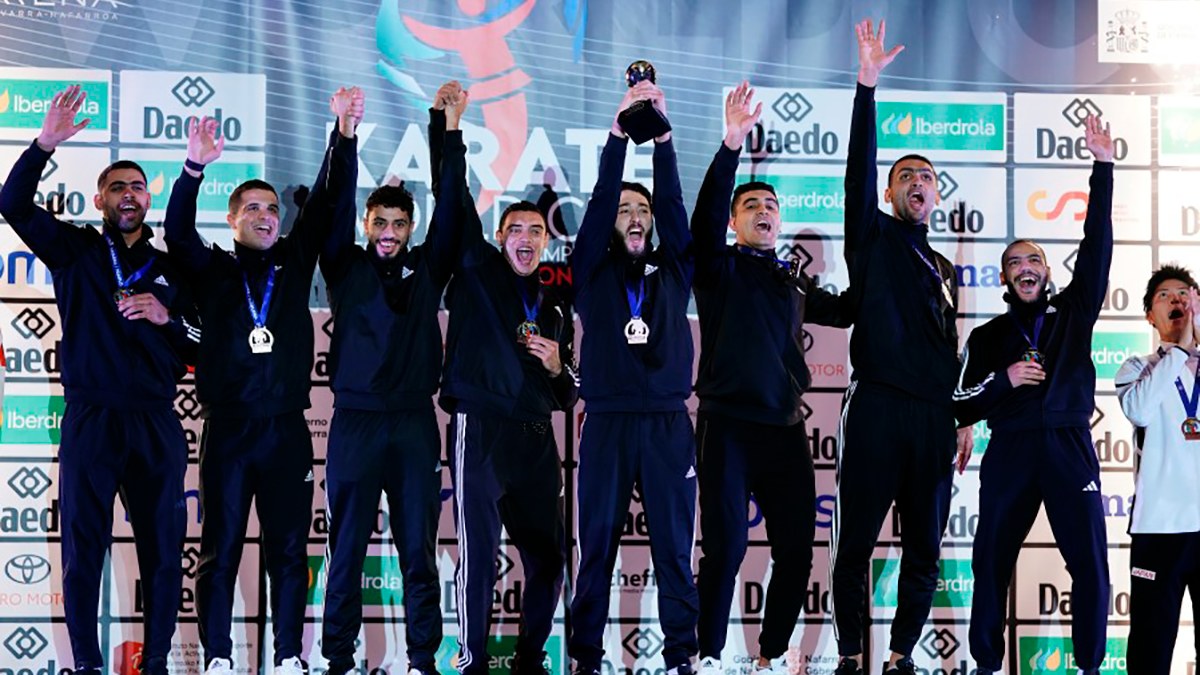

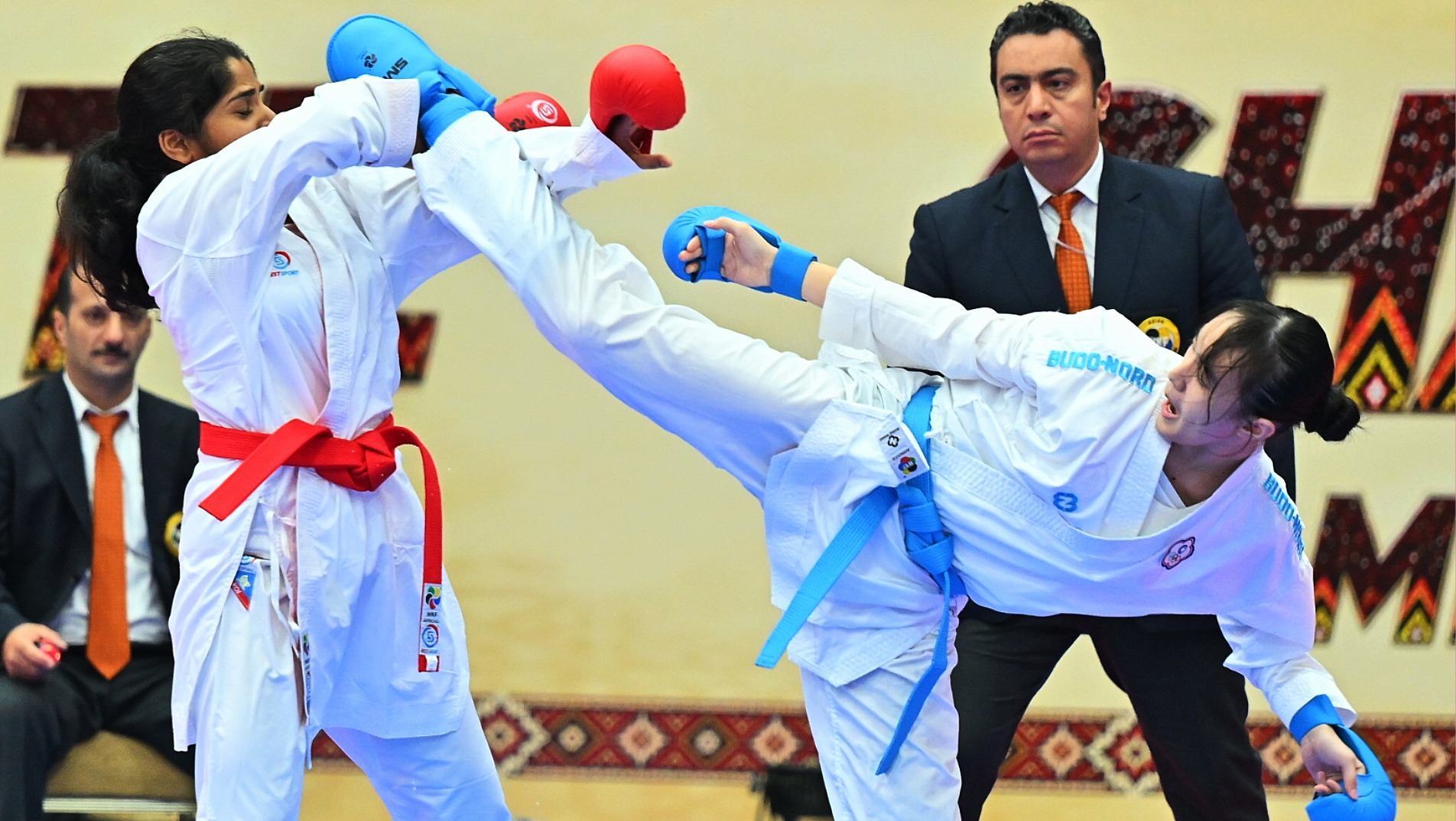
On Tuesday 8 September 2026, the AKF Cadet, Junior & U21 Championships delivered their first titles in Amman. At the Arena Complex in Al Hussein Youth City, Cadet kata and kumite and Cadet and Junior team kata opened the Asian Karate Federation's youth continental — scheduled 8–11 September under #KarateAmman2026. When the World Karate Federation published its opening-day wrap on 9 September, one storyline already stood out without a fabricated medal table: Iran had collected several gold medals and emerged as the leading nation, while Jordan, Saudi Arabia, Chinese Taipei, Thailand and Kuwait also reached the top of the podium.
The field that filled those tatami had been sketched a day earlier. A WKF competition-week preview spoke of nearly 400 young karate athletes from 21 countries, with Iran (41), hosts Jordan (40) and Chinese Taipei (39) at the head of the published numbers. Japan — gold leader at Shaoguan 2025 — is absent from this Amman edition after a mid-July Japan Karate Federation safety decision; that absence belongs to another piece already on the record. What Day 1 asked, and answered, was simpler: which of the federations that did arrive would set the early pace among Asia's cadets.
Iran's opening day across kata and kumite
Iran's day arrived as a sequence, not a single flash. In Cadet female kata, Dina Safari claimed the first individual kata gold of the championships, defeating Lanya Ahmed of Iraq in the final.
On the kumite side, three Iranian women stacked titles in successive weight categories: Nirvana Razzaghikomroudi took the Cadet female weight category −47 kg against Mahbooba Darsbaih of Palestine; Baran Shadfar won the weight category −54 kg against Hessah Alrasheed of Saudi Arabia; Dina Karimi completed the trio in the weight category −61 kg, defeating Alanoud Alasiri, also of Saudi Arabia.
The men's programme carried the same Iranian pressure in the middle weights. Abolfazl Arabyaghubi secured the Cadet male weight category −63 kg against Mohammed Harbi of Saudi Arabia; Hamidreza Rezayatizoj followed in the weight category −70 kg, beating Abdulrahman Alamri, again of Saudi Arabia. Those finals — Iranian gold against Saudi silver, twice — sketched a West Asian rivalry that may follow the week into the Junior and U21 bands.
Iran also reached both team-kata finals and the Cadet male kata final, and put athletes into further finals in the heaviest female and male kumite categories. Leading the opening day, in the WKF wrap's own words, meant multiple victories across kata and kumite — not a licence to invent totals. Qualitatively, that is enough: Iran set the pace; others interrupted it.
Thailand breaks the women's kumite sweep
The interruption the WKF wrap itself underlined came from Thailand. After Safari's kata title and the three Iranian women's kumite golds, Chonlada Nisangkat stopped Iran from taking a clean sweep of the female Cadet kumite categories. In the Cadet female weight category +61 kg, Nisangkat defeated Saba Khodaparast of Iran and put a Thai name on a board that had, for three successive women's kumite titles, belonged to Iran alone.
That single final matters beyond one medal's colour. Cadet continentals measure pathway depth as much as podium colour; a Thai gold against an Iranian finalist on Day 1 is an early signal of Southeast Asian progress in a week otherwise shaped, at the open, by West Asian power. Iran's pace was real — and it was not absolute.
Hosts Jordan find gold at home
Home success arrived twice, both times in Cadet male kumite. Mustafa Alnajjar won the Cadet male weight category −57 kg, defeating Lung Ho Lin of Chinese Taipei — a Jordanian gold that lit the Arena Complex for the hosts. Later, Tariq Ahmad claimed the Cadet male weight category +70 kg, overcoming Amir Ali Mohammadi of Iran.
Two host titles on the opening day do not rewrite the wider Iranian lead, but they place Jordan — already among the densest squads on the published field — on the medal board rather than only in the entry list. For a federation sitting at 40 athletes in the eve numbers published by the WKF, Day 1 delivered proof of conversion as well as presence.
Chinese Taipei's kata thread — individual and team
If Iran owned much of the kumite conversation, Chinese Taipei wrote the clearest kata counter-story. Hung-Yi Hsiao won the Cadet male kata title, defeating Iran's Sournakehi Mohammad Ankouti in the final — the first individual male kata gold of the championships, and a reminder that Chinese Taipei's 39-athlete squad was never only a numbers line in the field preview.
That individual gold then found a team echo. In Cadet and Junior female team kata, Chinese Taipei defeated Iran in the final to claim the continental title. Two Chinese Taipei golds on the opening day, both in kata, sketch a coherent national thread: precision work against Iranian pressure, individual and collective. The WKF wrap does not name the team members; inventing them would be invention. The result is enough — Taipei over Iran, on the same day Hsiao stood alone atop the men's cadet kata board.
Saudi Arabia's gold — and the silver lane against Iran
Saudi Arabia left Day 1 with a title of its own and with a pattern of proximity. Abdulrahman Alshammari became Cadet male champion in the weight category −52 kg, defeating Issa Ahmad Al Atma of Syria. Around that title clustered several Saudi finals against Iran: Alrasheed and Alasiri in the women's −54 kg and −61 kg; Harbi and Alamri in the men's −63 kg and −70 kg. This piece will not invent a Saudi medal total the WKF wrap did not print. What the finals show is a federation repeatedly one bout from the top step on a day Iran often occupied that step.
Kuwait's team kata gold closes the board
The last national colour on the opening-day champion list belonged to Kuwait. In Cadet and Junior male team kata, Kuwait overcame Iran in the final — another Iranian silver in a team discipline, and another reminder that leading the day is not the same as sweeping it. Chinese Taipei had already taken the women's team title against Iran; Kuwait completed the team-kata double for nations other than Iran. Together with Thailand's kumite interruption and Jordan's two home golds, those results keep the Amman opener open: Iran sets the pace; Asia answers in several voices.
First champions — the week continues
So Day 1 stands where the sources allow it to stand. Cadet kata titles for Dina Safari and Hung-Yi Hsiao; Cadet kumite titles for Razzaghikomroudi, Shadfar, Karimi, Nisangkat, Alshammari, Alnajjar, Arabyaghubi, Rezayatizoj and Tariq Ahmad; team kata titles for Chinese Taipei (women) and Kuwait (men). Iran as leading nation with several golds; no numbered medal table invented where the WKF published none. Japan's absence remains context, not the plot. Juniors and U21 still wait on the Amman tatami. Asia's first cadet champions of these AKF championships have their names; under #KarateAmman2026, the week in Amman has only begun.
Sources
- WKF — Iran Leads Opening Day as Future Karate Stars Shine at 2026 AKF Cadet, Junior & U21 Championships (9 Sep 2026)
- WKF — Asia's best young karate athletes ready for 2026 AKF Cadet, Junior & U21 Championships in Amman (7 Sep 2026)
- WKF — 2026 AKF Cadet, Junior & U21 Championships Amman
- Photos: Phonthawat Warasutthiphan / AKF — https://www.wkf.net/files/images/news/090926_akf_01_ok.jpeg ; https://www.wkf.net/files/images/news/090926_akf_01_02.png ; https://www.wkf.net/files/images/news/090926_akf_01_03.png ; https://www.wkf.net/files/images/news/090926_akf_01_04.png