

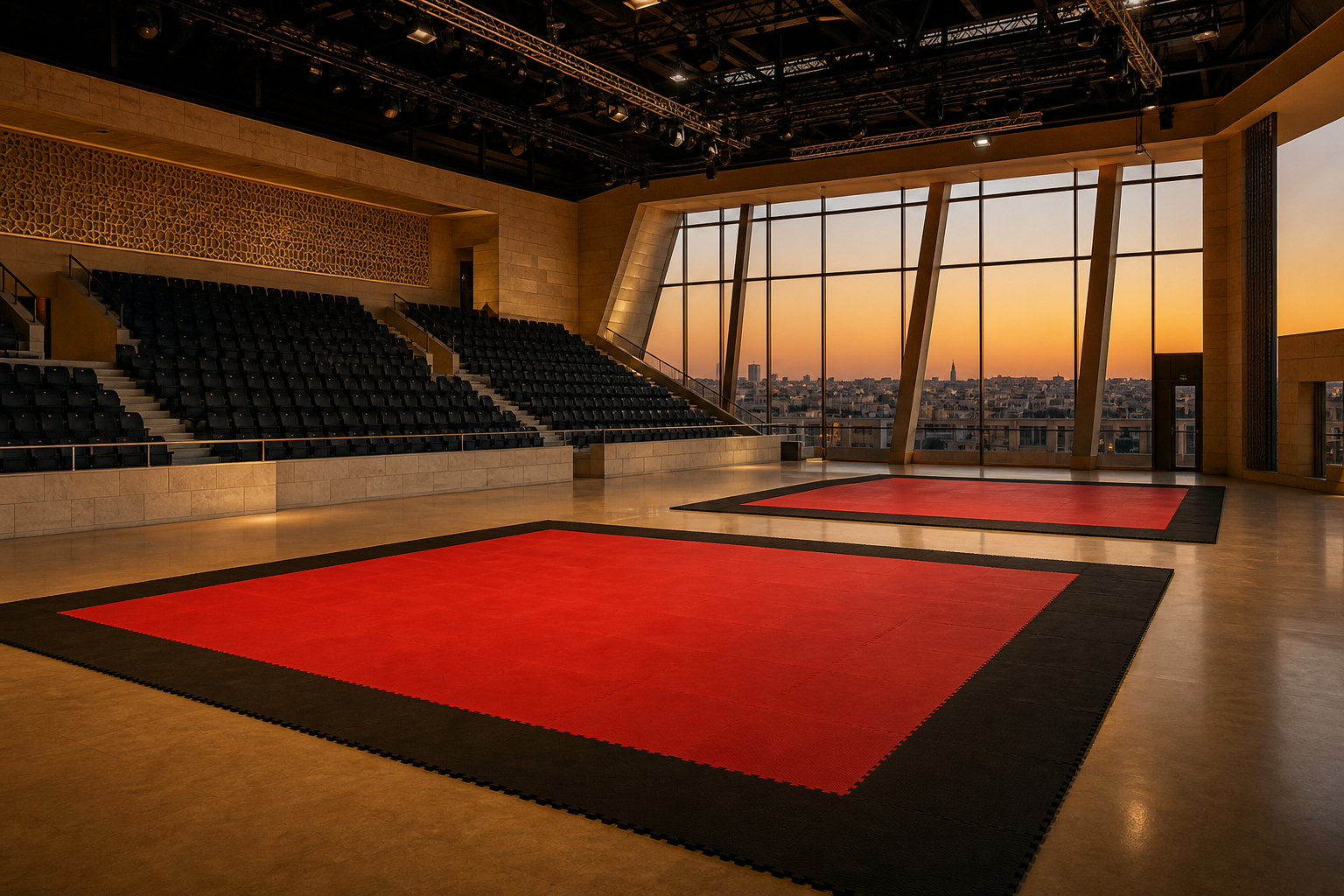
Asia’s next generation on the tatami for the continent
Barely five days after Mediterranean Games karate drew its curtain in Taranto, the continental youth calendar turns east, toward a capital that has spent weeks preparing for its moment under the lights. From Monday 8 to Thursday 11 September 2026, Amman will host the 24th Asian Cadet, Junior & U21 Karate Championships — Asia’s next generation stepping onto the tatami for the continent, under the public tag #KarateAmman2026, on a stage whose recent geography already runs through Almaty, Manila and Shaoguan.
The World Karate Federation and the official championships bulletin frame the competition window as 8–11 September 2026. Jordan’s Petra news agency, in a 1 September brief on national preparation, places the same gathering at the Arena Complex in Al Hussein Youth City yet cites a shorter span of 8–10 September — a discrepancy between sources worth recording without pretending to settle which calendar will govern the final day. On the essentials they converge: the venue is set, the hour is near, and the karategi will soon fill the hall. The WKF bulletin’s championship-venue line remains generic (“Championship Venue”); Petra’s Arena Complex naming supplies the concrete host-side detail retained here.
A continental youth stage in Amman
This is the youth continental after Taranto’s multi-sport close, and it sits squarely inside the WKF/AKF pathway rather than on the senior Premier League circuit. Previous hosts on the WKF page sketch the series’ geography with quiet clarity: Almaty in 2023, Manila in 2024, Shaoguan in 2025, and now Amman in 2026. Each edition gathers the continent’s cadet, junior and U21 cohorts at a moment when pathways toward senior continental programmes and Games selections are already taking shape.
The official bulletin structures Day 1 on 8 September around a cadet focus, with weigh-ins staged ahead of each age band: cadets on 7 September, juniors on 8 September and U21 on 9 September, all at the Championship Venue. That cadence — weigh-in the day before or on the morning of the relevant competition block — is the operational spine of the week as published by WKF/AKF, with the Jordan Karate Federation as hosting national federation.
Petra’s host-side snapshot puts the field at roughly 350 athletes from about 30 countries. The announced roll includes Jordan alongside Japan, China, Iran, Kazakhstan, India and a wide West Asian and Central Asian presence — Syria, Saudi Arabia, Qatar, Bahrain, Lebanon, Yemen, Kuwait, Palestine, Iraq, Chinese Taipei, Malaysia, Macao, Tajikistan, Kyrgyzstan, Oman, the Philippines, Myanmar, Sri Lanka, Nepal, Thailand, Turkmenistan, the UAE, Uzbekistan and Bangladesh among those named. Exact SportData entry tallies beyond that Petra estimate are not yet the public story; what the brief already conveys is continental breadth on home tatami for Jordan.
Jordan’s host push at Al Hussein Youth City
Competition is set, per Petra, for the Arena Complex in Al Hussein Youth City — a venue that, for a few September days, becomes the continent’s youth centre of gravity. The Jordan Karate Federation has been running a preparation camp focused on technical and physical readiness ahead of the championships, with the Sports Information Federation conveying high morale among the home squads and an explicit aim to present a strong image of Jordanian karate on the continental youth stage.
According to Petra, the hosts will field 40 male and female athletes across 38 kumite weight categories — a dense national deployment that underlines how seriously Amman is treating its continental at home. Spectator support at Al Hussein is expected to add further edge for athletes competing in front of a domestic crowd, the familiar alchemy of home tatami and home voices. Petra and the WKF bulletin’s liability framing both place the event as the 24th Asian Cadet, Junior and U21 Karate Championships, reinforcing continuity with the series that preceded them in China, the Philippines and Kazakhstan.
Officials, refereeing and continental governance
The week also carries a diplomatic and technical overlay. Petra reports that WKF president Antonio Espinós is due in Amman, with Asian Karate Federation president and WKF vice president Maj. Gen. Nasser Al-Razouqi and Ibrahim Al-Qannas, president of the Arab and West Asian karate federations, also expected. Their presence anchors the championships in the WKF/AKF governance chain — the institutional weight behind every bout on the edge of the tatami.
Running in parallel is a refereeing course under AKF supervision, with around 95 local, Arab and Asian referees scheduled to take part. The programme is designed to familiarise officials with the latest amendments to international rules and to include promotion examinations — a familiar continental accompaniment that keeps the youth championships tied to officiating development as much as to results in kumite and kata.
September densifies: Amman, Algiers, Guadalajara, Aichi-Nagoya
The timing is not incidental; it is the shape of the month itself. Mediterranean Games karate in Taranto closed on 1–2 September; Amman opens on the 8th. Before the Jordanian tatami cool, the UFAK African Championships in Algiers occupy 10–13 September — a continental overlap that compresses the global September picture into consecutive and concurrent windows. Mid-month, the Karate One Youth League in Guadalajara runs 17–20 September. Later in the same month, WKF’s calendar places Asian Games karate in Aichi-Nagoya on 20–23 September, turning mid-to-late September into a sequence that runs from a West Asian youth continental to Africa’s continental championships, on through a Youth League stop, and into the multi-sport Asian Games karate window in Japan.
That densification matters for how federations, coaches and athletes read the month. Amman is not an isolated youth stop; it is the first major Asian continental youth gathering of September, immediately after a Mediterranean Games close and immediately before — and briefly overlapping with — Africa’s continental championships, with Guadalajara and Aichi-Nagoya waiting further down the calendar. For Asia’s cadet, junior and U21 athletes, the Jordanian championships are the continental checkpoint of the moment: a place to measure form, deepen experience against a broad field, and sit inside a month that already stacks continental, Youth League and Games commitments.
What Amman asks of the field
Without start lists, forecasts or invented quotas, the preview stays where the sources allow. The field is wide; the host federation is invested; the officials’ course and the expected presence of Espinós, Al-Razouqi and Al-Qannas signal institutional weight; and the calendar around Amman is unusually crowded. Asia’s next generation steps onto the tatami in Al Hussein Youth City with #KarateAmman2026 as the public tag and with WKF’s 8–11 September frame — and the bulletin’s cadet-led Day 1 — as the governing competition window against Petra’s shorter published dates.
From Monday, the story moves from preparation briefs to competition proper: from the quiet of the camp to the noise of the arena, from weigh-ins to the first cadet bouts. Until then, Amman stands as the continental youth pivot of early September — Jordan hosting the 24th edition, Asia’s cadet-to-U21 pathway in focus, and the rest of the month already lining up behind it.
Sources
- WKF — 2026 AKF Cadet, Junior & U21 Championships Amman
- WKF Calendar
- WKF Bulletin PDF — 2026 AKF Cadet, Junior & U21 Championships
- WKF — 2026 Asian Games Aichi-Nagoya (karate competition)
- Petra — National Karate Teams Ready for Asian Youth Championships (1 Sep 2026)
- karate.news — Taranto 2026 Mediterranean Games karate Day 2 closing